Inside FedRAMP, Cloud, and AI
Analysis, guidance, and updates from the Knox team and industry leaders.
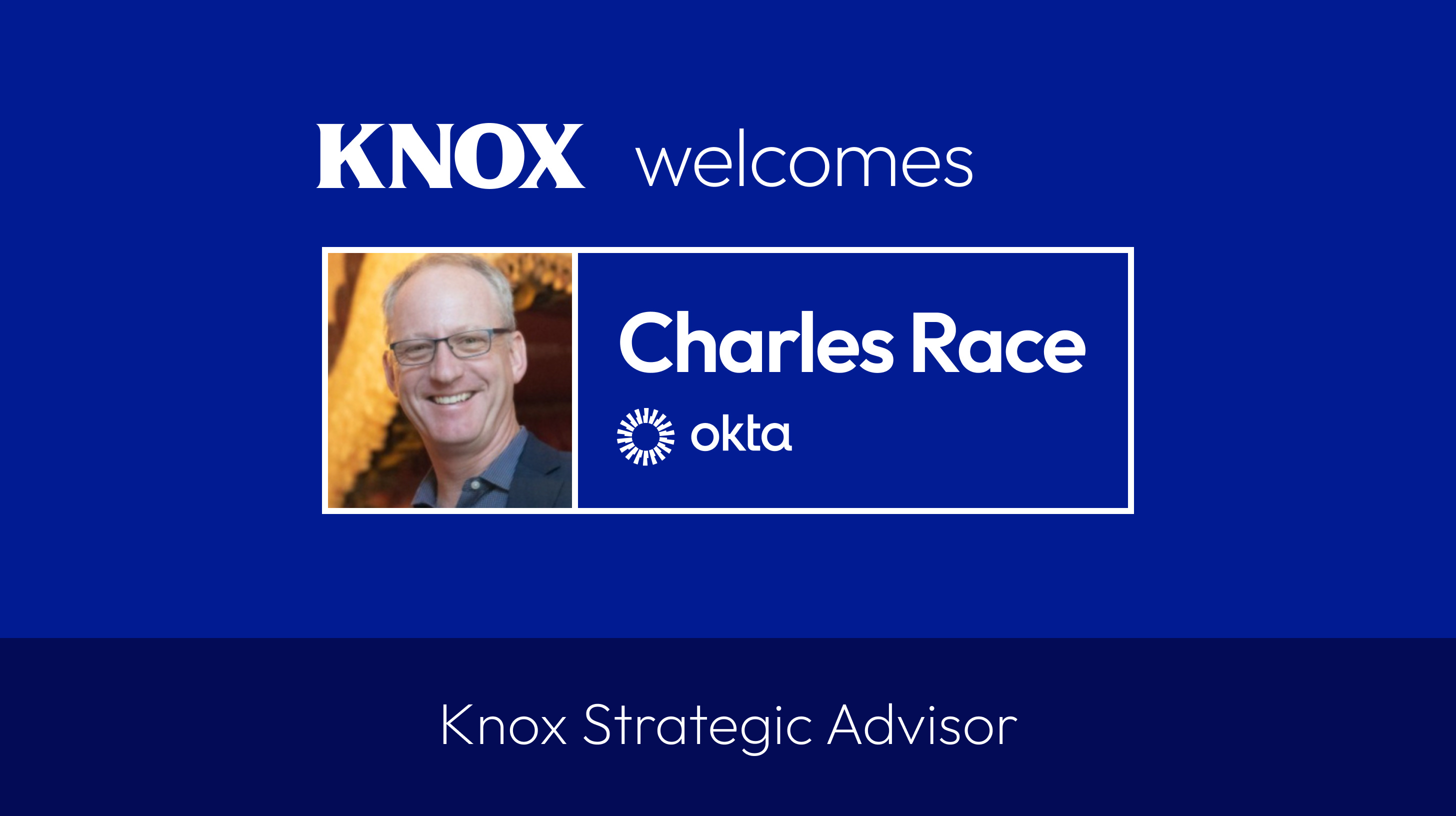
NEW YORK and SAN FRANCISCO — February 24, 2026 — Knox Systems today announced that Charles Race, former president of Okta and current general partner at Windproof Partners, has joined the company as a strategic advisor. Race brings decades of experience scaling identity, security, and cloud platforms at enterprise and government scale-expertise that will help guide Knox as it accelerates secure SaaS and AI adoption across federal agencies.
Race served as president of Okta, Inc. from 2016 to 2021, where he helped scale the company into a global leader in identity and access management, supporting millions of users across highly regulated industries. Today, as a general partner at Windproof Partners, Race advises and invests in companies building foundational infrastructure for secure, cloud-based systems.
As federal agencies modernize their technology stacks, identity, access, and trust have become central to mission success. Knox Systems enables agencies to adopt commercial SaaS and AI securely by providing a FedRAMP-authorized managed cloud and continuous compliance platform-removing the friction that slows modernization while strengthening security and resilience.
“Government modernization requires platforms that are secure by design and built to operate at scale,” said Charles Race, strategic advisor to Knox Systems. “Knox has established itself as a trusted partner to federal agencies by making it possible to adopt modern SaaS and AI fast without compromising security. I’m excited to support the team as they continue removing barriers to responsible innovation.”
“Charles has spent his career building and scaling trust on the internet,” said Irina Denisenko, CEO of Knox Systems. “His leadership at Okta helped define how organizations think about identity and security at scale. As government agencies increasingly rely on cloud and AI, his leadership will be invaluable as we help them modernize securely and responsibly.”
Knox Systems operates the largest federal managed cloud and is trusted by leading defense and civilian agencies to secure some of the government’s most critical systems. With more than 15 active ATOs and a decade of operational experience, Knox continues to set the standard for fast, resilient, and compliant federal cloud adoption.
About Knox Systems
Knox Systems operates the largest managed federal cloud, trusted by top agencies and partners across defense and civilian sectors. Built for speed, resilience, and compliance, Knox delivers FedRAMP authorization in 90 days - turning the biggest bottleneck in government IT into the fastest path to modernization. Knox proudly serves Adobe, Celonis, Outsystems, Armis, BigID and more AI and SaaS providers, accelerating secure innovation across the federal landscape. Learn more at www.knoxsystems.com.
Media Contact:
media@knoxsystems.com
Knox Systems Appoints Former Okta President Charles Race as Strategic Advisor
Knox Systems Appoints Former Okta President Charles Race as Strategic Advisor
SAN FRANCISCO, April 29, 2025 /PRNewswire/ -- RSA CONFERENCE -- Spacelift, creator of the infrastructure orchestration platform that manages the entire infrastructure lifecycle, today announced a partnership with Knox Systems under which the Spacelift Platform will achieve FedRAMP authorization and expand access to U.S. government customers. As part of the partnership, Knox Systems will use Spacelift as its infrastructure-as-code (IaC) platform of record to manage and scale its secure cloud environment across AWS, Azure and GCP.
The announcement was made this morning at the RSA Conference in San Francisco.
Federal Risk and Authorization Management Program (FedRAMP) provides a standardized, reusable approach to security assessment and authorization for cloud service offerings. This partnership will allow Spacelift to deliver its secure and scalable IaC platform to federal agencies by leveraging Knox's purpose-built, FedRAMP-ready cloud environment. The arrangement means that Spacelift is now on track to achieve FedRAMP authorization quickly, bringing flexible, policy-driven infrastructure automation to federal developers and DevSecOps teams.
As Knox grows its multi-cloud FedRAMP boundary and supports mission-critical applications for government-facing SaaS vendors, the Spacelift Platform will provide the automation, policy enforcement and control necessary for Knox to deploy infrastructure securely, consistently and at scale. The partnership reinforces Knox's commitment to delivering secure, scalable and compliant infrastructure for software vendors looking to enter and grow in the public sector.
"This partnership helps both our companies move more rapidly in providing vital automation and control capabilities to the U.S. government," said Pawel Hytry, CEO of Spacelift. "Knox has a purpose-built boundary and streamlined FedRAMP approach that makes it possible for us to meet the government's high bar for security—without slowing down our roadmap."
"Spacelift is exactly the kind of modern, developer-first platform we want to bring to government buyers," said Irina Denisenko, CEO of Knox. "The Spacelift Platform was the clear choice for our mission critical environments. They deliver the power and flexibility we need to manage a growing, complex infrastructure with confidence. The partnership will unlock a massive new market while empowering agencies to manage infrastructure more securely and efficiently."
About Spacelift
Spacelift is an infrastructure orchestration platform that manages the entire infrastructure lifecycle – provisioning, configuration and governance. Spacelift integrates with existing infrastructure tooling (e.g., Terraform, OpenTofu, CloudFormation, Pulumi, Ansible) to provide a single integrated workflow to deliver secure, cost-effective and resilient infrastructure, fast.
By automating deployment and configuration, providing developer self-service, golden paths with guardrails, and an OPA policy engine, Spacelift empowers businesses to accelerate developer velocity while maintaining control and governance over their infrastructure. Sign up for a demo or a free trial at spacelift.io.
About Knox Systems
Knox is the fastest way for SaaS vendors to get FedRAMP-ready and sell to the U.S. Government. Learn more at knoxsystems.com.
Media Contact
Cristin Connelly
Cathey.co for Spacelift
cristin@cathey.co
SOURCE Spacelift

Spacelift Partners with Knox Systems to Fast-Track FedRAMP Authorization and Bring Secure, Scalable Infrastructure to the Knox FedRAMP Platform
Spacelift Partners with Knox Systems to Fast-Track FedRAMP Authorization and Bring Secure, Scalable Infrastructure to the Knox FedRAMP Platform
NEW YORK and WASHINGTON, Dec. 9, 2025 /PRNewswire/ -- BigID, the leader in data security, privacy, compliance and AI governance, continues its momentum as one of the fastest-growing leaders in data security, privacy, and AI governance announced at the DCA Live Capital Capital Dual Use Event that it is advancing its federal strategy with a rapid path to FedRAMP authorization in partnership with Knox. This move will accelerate how U.S. federal agencies adopt modern data and AI security and unlock BigID's breakthrough AI-driven innovation across civilian, defense, and intelligence missions.
The BigID platform, already deployed across federal agencies, helps teams reduce data and AI risk, meet regulatory mandates, and modernize how they manage sensitive data at scale. It provides unified discovery and controls across cloud, SaaS, and on-prem environments, enforces privacy and security automatically, and strengthens mission resilience with continuous, intelligent governance. By streamlining compliance, BigID lets agencies focus on mission outcomes instead of administration.
Optimized for classified, air-gapped, and hybrid architectures, BigID meets the operational demands of federal agencies and aligns with key government standards including NIST SP 800-53, CMMC, FISMA, EO 14028, and the DoD Zero Trust Framework.
Through its partnership with Knox, BigID is set to achieve this critical authorization in months rather than years. Knox's federal managed cloud, the largest FedRAMP-authorized cloud platform in operation, provides BigID with an accelerated path that bypasses the traditional three-year, multi-million-dollar authorization cycle. The collaboration positions BigID to deliver its platform to federal customers at unmatched speed and scale.
"Federal agencies are at a tipping point – the explosion of sensitive data demands more than traditional compliance tools. It requires deep intelligence and automation," said Brian Rosson, Vice President of Federal at BigID. "By teaming with Knox to rapidly achieve FedRAMP authorization we are extending these capabilities to every corner of government at the pace Federal modernization demands."
By eliminating the FedRAMP authorization bottleneck, Knox reduces compliance timelines from years to approximately 90 days – enabling agencies to adopt secure SaaS and AI solutions at the highest federal standards. Importantly, Knox integrates AI-driven compliance monitoring and real-time threat detection to identify vulnerabilities early and protect mission-critical systems from emerging cyber risks. This means agencies gain faster deployment, lower compliance costs, real-time security insights, and a trusted environment to innovate safely within Federal cloud frameworks.
"Our government needs advanced platforms like BigID to ensure that Federal agencies have mastery over their most critical asset – data," said Irina Denisenko, CEO of Knox. "By expediting BigID's FedRAMP journey, we are making it possible for agencies to unlock new value from their data while upholding the strongest standards of trust, security and compliance. This is about ensuring AI and cloud adoption happen responsibly at the speed our nation requires."
About BigID
BigID helps organizations connect the dots in data & AI: for security, privacy, compliance, and AI data management. BigID enables customers to find, understand, manage, protect, and take action on high-risk & high-value data, wherever it lives.
Customers use BigID to reduce their AI & data risk, automate security and privacy controls, achieve compliance, and understand their data throughout their entire data landscape: from the cloud, on-prem, and everywhere in between.
BigID has been recognized for innovation as a World Economic Forum Technology Pioneer; named to the Forbes Cloud 100; the Inc 5000 for 4 consecutive years; the Deloitte 500 for 4 consecutive years; Market Leader in Data Security Posture Management (DSPM); Leader in Privacy Management in the Forrester Wave; and an RSA Innovation Sandbox winner.
Learn more at www.bigid.com.
About Knox Systems
Knox Systems runs the largest FedRAMP Authorized managed cloud platform in the world, bringing a decade-long track record of secure and compliant operations. Trusted by Adobe since 2014, Knox Systems streamlines the path to FedRAMP authorization, enabling vendors to achieve FedRAMP in just 90 days across AWS, Azure, and GCP. Learn more at www.knoxsystems.com.
SOURCE BigID
BigID Accelerates FedRAMP Authorization with Knox Systems to Power the Next Generation of Federal Data Security
BigID Accelerates FedRAMP Authorization with Knox Systems to Power the Next Generation of Federal Data Security
WASHINGTON and NEW YORK, Feb. 5, 2026 /PRNewswire/ -- Kovr.ai, the only AI-native cyber compliance automation platform, today announced it has achieved Federal Risk and Authorization Management Program (FedRAMP) authorization in record-breaking time. By completing the process in just six weeks, Kovr.ai has established the fastest FedRAMP authorization cycle to date, clearing the way for federal agencies and regulated enterprises to deploy automated compliance tools inside secure government environments.
The milestone was achieved through a strategic partnership with Knox Systems. The authorization was achieved through the unique combination of Knox Systems' managed federal cloud boundary and Kovr.ai's AI-native platform, which automatically generates gap analyses, Security Change Requests (SCRs), and the full suite of compliance artifacts required to accelerate the Authorization to Operate (ATO) process. By integrating Kovr.ai's AI-native engine directly into Knox Systems' environment, the companies have successfully compressed a process that typically consumes 18 to 24 months into a 42-day sprint.
"Traditional FedRAMP authorization is a manual, exhaustive process that costs organizations hundreds of thousands of dollars and years of effort," said Sri Iyer, co-founder and Chief Technology Officer of Kovr.ai. "Kovr's platform delivers real-time, code-driven intelligence to automate compliance with programs like FedRAMP and CMMC. By slashing the time and cost of achieving an ATO, we are proving that security doesn't have to be a barrier to speed."
The authorization highlights a new model for federal cloud security: Knox Systems provides the robust federal cloud infrastructure and inherited controls, while Kovr.ai's platform provides real-time assessment against National Institute of Standards and Technology (NIST) Special Publication 800-53 requirements and Open Security Controls Assessment Language (OSCAL)-based documentation for continuous monitoring. Together, Knox and Kovr.ai have created a new model for federal cloud authorization: enterprise-grade security infrastructure paired with AI-powered compliance automation that compresses years of manual effort into weeks.
"Kovr.ai represents the exact kind of innovation FedRAMP was designed to unlock," said Irina Denisenko, CEO of Knox Systems. "By operating within the Knox boundary, Kovr achieved authorization in a small fraction of the usual timeline. This is definitive proof that modern AI platforms can meet the most stringent federal security standards without the legacy delays."
Founded by former executives from AWS, Gartner, and PwC, Kovr.ai is a pioneer in the DevOps Continuous Compliance Automation (DCCA) market. As a "compliance copilot," the platform integrates with existing DevSecOps toolchains to provide agencies and vendors a faster, more reliable path to both initial ATO and ongoing assurance through agentic continuous monitoring.
"Compliance shouldn't slow innovation—it should enable it," said Andrew Black, co-founder and CEO of Kovr.ai. "Achieving this authorization through our partnership with Knox demonstrates that AI and automation can meet the highest standards of government security. We are excited to bring these capabilities to the federal ecosystem, helping agencies move faster while remaining mission-ready."
About Kovr.ai
Kovr.ai reinvents cyber-compliance automation with the only AI-native platform designed for cloud and hybrid systems to meet the demands of highly regulated industries. Built on NIST 800-53, NIST 800-171, and OSCAL standards, Kovr.ai eliminates manual processes and enables real-time visibility, audit-ready reporting, and automated remediation across frameworks like FedRAMP and CMMC. Trusted by enterprises and government innovators alike, Kovr.ai helps organizations modernize securely and at speed. Learn more at www.kovr.ai.
About Knox Systems
Knox Systems operates the largest managed federal cloud, trusted by top agencies and partners across defense and civilian sectors. Built for speed, resilience, and compliance, Knox delivers FedRAMP authorization in 90 days — turning the biggest bottleneck in government IT into the fastest path to modernization. Kovr.ai joins a growing list of AI and SaaS providers authorized through the Knox boundary, accelerating secure innovation across the federal landscape. Learn more at www.knoxsystems.com.
Media Contact
Knox@w2comm.com
Kovr.ai Partners with Knox Systems to Achieve Fastest Ever FedRAMP Authorization - Delivering AI-Native Compliance Across Government and Regulated Enterprises
Kovr.ai Partners with Knox Systems to Achieve Fastest Ever FedRAMP Authorization - Delivering AI-Native Compliance Across Government and Regulated Enterprises
BOSTON--(BUSINESS WIRE)--OutSystems, a leading AI development platform, today announced that it has achieved Federal Risk and Authorization Management Program (FedRAMP) Authorization. With this certification, OutSystems now offers U.S. federal agencies an authorized, full-stack custom application development platform designed to deploy and manage mission-critical applications while meeting the government’s data security requirements.
A rigorous and exclusive U.S. government program, FedRAMP is designed to standardize security assessment and authorization for cloud service offerings, accelerating the adoption of government-grade cloud solutions by federal agencies. OutSystems has partnered with Knox, the largest and longest-running managed federal cloud provider, to achieve FedRAMP Authorization.
The FedRAMP-Authorized OutSystems platform combines enterprise-grade software development with end-to-end, full-stack cloud development. Unlike process-centric platforms and custom development, OutSystems eliminates vendor lock-in and gives federal agencies the speed and flexibility required to support a wide range of federal use cases, from frontline digital services to deeply customized mission systems - on a FedRAMP-Authorized platform
“Federal agencies face a modernization paradox: they must rapidly improve digital services and upgrade aging systems, but are constrained by shrinking budgets, limited IT staffing, and stringent security requirements,” said Woodson Martin, CEO at OutSystems. “The FedRAMP-Authorized OutSystems platform is designed to solve these modernization challenges by enabling federal agencies to accelerate digital transformation while reducing risk, controlling costs, and maintaining long-term ownership and scalability.”
The platform empowers federal agencies to build custom digital services tailored to their specific mandates—from citizen-facing web and mobile services, such as benefits portals, grants intake, and field inspections, to complex case management, program oversight, and core mission systems. FedRAMP-Authorized OutSystems helps federal agencies achieve:
- Fast, Phased Modernization
OutSystems enables agencies to rapidly build and modernize mission-critical digital services without a rip-and-replace strategy. Reusable components, acceleration tools, and easy integration with existing systems accelerate time to value. - Mission-Centric Agility with Ownership and Control
OutSystems empowers agencies to deliver any digital service—from citizen-facing web and mobile experiences to complex case management and core mission systems. Its application-centric architecture, extensibility, and customization enable long-term ownership of IP without vendor lock-in. - Enterprise-Grade Security, Governance, and Compliance
OutSystems delivers government-grade security and reliability by design through a FedRAMP-Authorized cloud environment in partnership with Knox. Built-in security controls, automated DevSecOps, high availability, and centralized governance ensure consistent compliance, operational resilience, and predictable costs across the application portfolio.
“Federal agencies increasingly require platforms that combine speed with the flexibility to support highly specialized mission requirements,” said Carrie Lee, former Chief Product Officer and Deputy CIO for the Department of Veterans Affairs. “OutSystems FedRAMP Authorization expands access to a full-stack customer application development platform capable of modernizing complex legacy systems while enabling incremental, lower-risk transformation.”
“Modernization in government too often stalls at compliance,” said Irina Denisenko, CEO of Knox Systems. “Partnering with OutSystems helps turn FedRAMP from a blocker into an enabler - unlocking secure, scalable access to modern development capabilities for federal agencies.”
Learn more about FedRAMP-Authorized OutSystems here.
About OutSystems
OutSystems is a leading AI development platform trusted by thousands of customers worldwide. The platform empowers CEOs, management teams, and technology leaders to build mission-critical applications and agentic systems that grow revenue, streamline operations, and deliver exactly what businesses need.
While evolving AI pilots into production success can be challenging due to talent gaps, legacy systems, imperfect data, and sprawling point solutions, OutSystems provides a proven AI development platform and experience that enables innovation up to 10x faster with the assurance of built-in security, scalability, and governance.
Recognized as a leader by analysts, IT executives, business leaders, and developers around the world, global brands trust OutSystems to innovate as fast as the evolving market demands and orchestrate powerful human + AI collaboration in the agentic future.
Founded in 2001, the company’s network spans more than 60 million end users, over 500 partners, and active customers in 75+ countries across 20+ industries. Learn more at www.outsystems.com.
Contacts
Media Contact:
Shayna Chapel
pr@outsystems.com
OutSystems Achieves FedRAMP Authorization to Accelerate Digital Modernization Across U.S. Federal Agencies
OutSystems Achieves FedRAMP Authorization to Accelerate Digital Modernization Across U.S. Federal Agencies
NEW YORK and RESTON, Va. — February 3, 2026 — Knox Systems, the largest FedRAMP managed cloud solution, and Carahsoft Technology Corp., The Trusted Government IT Solutions Provider®, today announced a partnership. Under the agreement, Carahsoft will serve as Knox Systems’ Master Government Aggregator®, making Knox’s Federal Risk and Authorization Management Program FedRAMP®-authorized managed cloud and AI security platform available to the Public Sector, independent software vendors (ISVs) and commercial customers through Carahsoft’s reseller partners and NASA Solutions for Enterprise-Wide Procurement (SEWP) V, Information Technology Enterprise Solutions – Software 2 (ITES-SW2), National Association of State Procurement Officials (NASPO) ValuePoint and OMNIA Partners contracts.
As Government agencies accelerate the adoption of Software as a Service (SaaS) and artificial intelligence (AI), security, compliance and cost remain persistent barriers. Knox Systems eliminates these barriers by delivering FedRAMP-grade cloud infrastructure and continuous compliance monitoring, enabling organizations to quickly deploy modern SaaS and AI tools without compromising security or mission resilience.
“Government agencies want access to the best commercial SaaS and AI technologies, but legacy infrastructure and compliance complexity often slow progress,” said Irina Denisenko, CEO of Knox Systems. “By partnering with Carahsoft, we are expanding access to Knox’s secure managed cloud and continuous compliance capabilities, giving agencies a faster, lower-risk path to modernize while meeting the highest Federal security standards.”
The partnership with Carahsoft and its reseller partners provides Public Sector agencies, ISVs and commercial customers with seamless access to Knox Systems’ compliance solutions. The company’s solutions enable organizations to assess, deploy and secure SaaS and AI applications using NIST 800-53 controls, the foundation of FedRAMP compliance, while maintaining real-time visibility into risk and configuration drift.
Federal agencies face increasing pressure to move away from legacy, on-premise infrastructure and toward commercial off-the-shelf cloud solutions. While SaaS adoption improves efficiency and security, only a fraction of available commercial tools are authorized for Federal use. Knox closes the gap by providing agencies with a compliant cloud environment to securely run SaaS and AI applications, streamlining authorization and reducing ongoing operational burden.
“Knox Systems’ managed cloud and compliance capabilities empower organizations to modernize rapidly while ensuring adherence to critical Federal security requirements,” said Alex Whitworth, Cybersecurity Solutions Vertical Executive at Carahsoft. “The company’s platform helps Government agencies, ISVs and commercial customers reduce security risks, automate compliance processes and maintain secure IT environments. Carahsoft and its reseller partners look forward to working with Knox Systems to deliver modern cloud and AI technologies to the Public Sector.”
Knox Systems’ solutions are available through Carahsoft’s SEWP V contracts NNG15SC03B and NNG15SC27B, ITES-SW2 Contract W52P1J-20-D-0042, NASPO ValuePoint Master Agreement #AR2472 and OMNIA Partners Contract #R240303. For more information, contact the Carahsoft Team at (844) 445-5688 or KnoxSystems@carahsoft.com. Explore Knox Systems solutions here.
For more information about Knox Systems, visit www.knoxsystems.com.
About Knox Systems
Knox Systems operates the largest Federal managed cloud, trusted by defense and civilian agencies to run mission-critical workloads securely. Built for speed, resilience and compliance, Knox delivers FedRAMP-authorized cloud infrastructure, continuous compliance monitoring and automated remediation that enable agencies to adopt SaaS and AI with confidence.
Contact
Knox Systems
media@knoxsystems.com
About Carahsoft’s Cybersecurity Solutions Portfolio
Carahsoft's Cybersecurity solutions portfolio includes leading and emerging technology vendors who enable organizations to defend against cyber threats, manage risk and achieve compliance. Supported by dedicated Cybersecurity product specialists and an extensive ecosystem of resellers, integrators and service providers, we help organizations identify the right technology for unique environments and provide access to technology solutions through our broad portfolio of contract vehicles. The cybersecurity portfolio spans solutions for Supply Chain Risk Management, Cloud Security, Zero Trust, Network & Infrastructure, Identity & Access Management, Risk & Compliance and more, ensuring comprehensive protection for organizations' cyber ecosystems. Explore Carahsoft’s Cybersecurity Solutions for Government here.
About Carahsoft
Carahsoft Technology Corp. is The Trusted Government IT Solutions Provider, supporting Public Sector organizations across Federal, State and Local Government agencies and Education and Healthcare markets. As the Master Government Aggregator for our vendor partners, we deliver solutions for Cybersecurity, MultiCloud, DevSecOps, Artificial Intelligence, Customer Experience and Engagement, Open Source and more. Working with resellers, systems integrators and consultants, our sales and marketing teams provide industry leading IT products, services and training through hundreds of contract vehicles. Visit us at www.carahsoft.com.
Contact
Mary Lange
(703) 230-7434
PR@carahsoft.com
View source version on GlobeNewswire

Knox Systems and Carahsoft Partner to Accelerate Secure SaaS, AI Adoption Across the Public Sector
Knox Systems and Carahsoft Partner to Accelerate Secure SaaS, AI Adoption Across the Public Sector

Get FedRAMP SaaS Authorized in Lightning Speed | 90 Days for 90% Less
Get FedRAMP SaaS Authorized in Lightning Speed | 90 Days for 90% Less
BigID Selects Knox to Achieve FedRAMP Authorization
BigID Selects Knox to Achieve FedRAMP Authorization

John Zangardi Joins Knox Systems Federal Advisory Board
John Zangardi Joins Knox Systems Federal Advisory Board
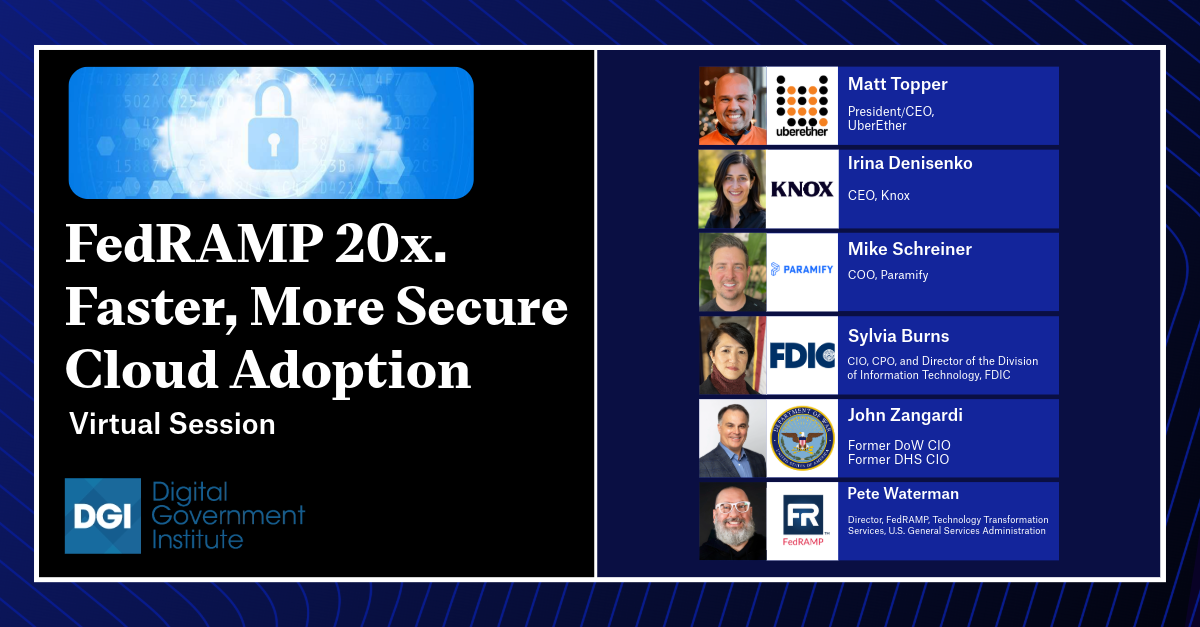
As federal agencies face mounting pressure to modernize, the FedRAMP program is undergoing its most significant evolution to date. To explore these changes, Knox Systems CEO Irina Denisenko and Federal Advisor John Zangardi recently joined the Digital Government Institute (DGI) for a virtual workshop titled FedRAMP 20x: Faster, More Secure Cloud Adoption.
The session brought together government leaders and industry experts to discuss the shift toward engineering-driven compliance and the collaborative efforts required to shrink authorization timelines from years to months.
Watch the Full Workshop Recording Here
Key Highlights
- Process Evolution: How FedRAMP is moving beyond paper-based checklists to securely streamline authorizations.
- Government-Industry Synergy: Insights into the developing partnerships that are breaking down traditional silos between the public and private sectors.
- Speed Without Sacrifice: Strategies for accelerating the path to FedRAMP authorization while maintaining—or even enhancing—security posture.
- Engineering-Driven Compliance: A look at how automated validation is replacing manual sampling in the audit process.
The Shift Toward Engineering-Driven Compliance
During the workshop, the discussion pivoted on a critical realization: the old way of achieving FedRAMP is no longer sustainable. John Zangardi and Irina Denisenko explored how "engineering-driven compliance" allows SaaS providers to build security into their code from day one.
By moving away from static documentation and toward machine-readable evidence (OSCAL), the government is striving to dramatically accelerate timelines. This shift ensures that agencies can adopt cutting-edge commercial innovation—including AI and advanced analytics—at the speed of mission requirements.
Modernizing the Path to Authorization
The DGI workshop emphasized that the "20x" goal isn't just a number—it’s a mandate for cultural and technical change. For SaaS vendors, this means leveraging shared boundaries and inherited controls to reduce the "compliance surface area." This approach allows vendors to focus on their core product while inheriting the heavy lifting of infrastructure security from authorized platforms like Knox.
Frequently Asked Questions
1. What was the focus of the DGI FedRAMP 20x Workshop? The workshop focused on the programmatic and technical shifts within FedRAMP aimed at speeding up cloud adoption without compromising the rigorous security standards required by federal agencies.
2. What is "Engineering-Driven Compliance"? It is the practice of automating security control validation through code and continuous monitoring. This reduces the manual burden of traditional audits and provides real-time visibility into a system's security posture.
3. How are government and industry partnering to improve FedRAMP? Through initiatives like FedRAMP 20x, there is increased transparency and data sharing between CSPs and agencies. This collaboration helps identify bottlenecks early and standardizes the requirements for faster reuse of security packages.
4. Can Knox Systems help us prepare for these new FedRAMP 20x standards? Absolutely. Knox is built on the exact principles discussed in this workshop: automation, inheritance, and speed. We help SaaS teams reach "Audit Ready" status in 90 days or less by providing a pre-authorized environment.
Is your SaaS ready for the new era of federal compliance? Book a Demo to see how we automate the path to FedRAMP.
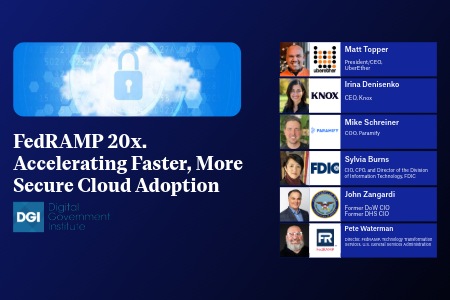
FedRAMP 20x: Accelerating Faster, More Secure Cloud Adoption
FedRAMP 20x: Accelerating Faster, More Secure Cloud Adoption
In a major move to accelerate federal cloud adoption, Knox Systems has officially launched on the Google Cloud Marketplace. This partnership provides Google Cloud Platform (GCP) SaaS vendors with a streamlined, high-speed pathway to FedRAMP authorization, effectively removing the traditional barriers of cost and complexity.
By integrating directly with GCP, Knox allows innovative software providers to achieve FedRAMP Moderate or DISA IL4 readiness in as little as 90 days—a timeline previously unheard of in the federal sector.
View the Full Announcement on PR Newswire
Key Highlights
- Google Cloud Partnership: SaaS vendors can now procure Knox directly through the GCP Marketplace, simplifying procurement and billing.
- The 90-Day Sprint: A structured, four-phase approach to move vendors from discovery to "Audit Ready" status in record time.
- Cost Efficiency: Achieving FedRAMP at a fraction of the traditional cost by leveraging Knox’s pre-authorized boundary.
- GCP-Native Optimization: Seamless integration for applications already built on Google Cloud infrastructure.
Unlocking the Federal Market for GCP Innovators
For many SaaS companies built on Google Cloud, the "FedRAMP hurdle" has historically kept them from pursuing lucrative government contracts. The availability of Knox on the GCP Marketplace changes that dynamic.
This collaboration allows vendors to focus on what they do best—building innovative software—while "inheriting" the complex security controls required by federal mandates. "By meeting SaaS vendors where they already are—on Google Cloud—we are removing the friction that has traditionally slowed down public sector innovation," says Knox leadership.
Streamlined Procurement and Compliance
By listing on the Marketplace, Knox enables organizations to use their existing Google Cloud commits to fund their FedRAMP journey. This not only speeds up the technical side of compliance but also streamlines the internal financial approvals required to launch a federal GTM strategy.
Frequently Asked Questions
1. What does the Knox listing on Google Cloud Marketplace mean for my business? It means you can now purchase Knox’s FedRAMP acceleration services directly through your GCP account, potentially using existing cloud credits and simplifying your vendor management process.
2. How does Knox achieve FedRAMP readiness in 90 days? Knox utilizes a "Security by Inheritance" model. Because our boundary is already authorized, GCP vendors can inherit over 80% of the required security controls, focusing only on their application-level data and logic.
3. Does this support DISA IL4 for Department of Defense (DoD) contracts? Yes. The Knox platform is designed to support both FedRAMP Moderate and DISA Impact Level 4 (IL4) requirements, making it ideal for vendors looking to serve both civilian and defense agencies.
4. Why is this partnership significant for the federal government? It increases the diversity of secure tools available to agencies. By making it easier for GCP-native SaaS companies to get authorized, the government gains faster access to a wider range of cutting-edge innovation.
Ready to launch your GCP-native app in the federal market? Book a Demo to start your 90-day sprint today.

Knox Systems Now Available on Google Cloud Marketplace: Delivering a 90-Day Path to FedRAMP for GCP SaaS Vendors
Knox Systems Now Available on Google Cloud Marketplace: Delivering a 90-Day Path to FedRAMP for GCP SaaS Vendors
January 27, 2026 - For years, federal agencies have operated under the traditional belief that IT modernization requires a choice between speed and security. However, as modernization mandates accelerate, this "speed vs. security" paradox is being dismantled.
In a recent featured article for Washington Technology, Knox Systems leadership explores how modern cloud-based solutions are now delivering both—and why the traditional barriers to FedRAMP authorization are finally coming down. With the arrival of FedRAMP 20x, the federal market is shifting toward a reality where mission outcomes are delivered in weeks, not years.
Read the Full Article on Washington Technology
Key Highlights
- The Modernization Mandate: Why federal agencies can no longer afford to let compliance bottlenecks stall critical IT updates.
- Debunking the Paradox: How cloud-native security allows for rapid deployment without compromising government-grade protection.
- FedRAMP 20x as a Catalyst: How the new program initiative is opening doors for SaaS vendors to meet growing agency demand.
- Weeks, Not Years: A look at the new standard for mission delivery and what it means for the future of government procurement.
Answering the Call for Scalable Innovation
The demand for secure, scalable innovation within the federal government has never been higher. As agencies signal a shift away from legacy systems, the primary hurdle remains the FedRAMP authorization process.
The article highlights that while FedRAMP has historically been seen as a barrier, the move toward automated, "ready-now" compliance boundaries is changing the landscape. By leveraging inheritance and engineering-driven security, SaaS vendors can now answer the government's call for innovation without the multi-year wait times of the past.
The Future of Mission-Ready Tech
The connection between agency modernization and cloud adoption is irrefutable. For SaaS providers, the message is clear: the infrastructure to support rapid, secure federal entry now exists. The goal is to move from a "compliance-first" mindset to a "mission-first" reality, where technology serves the agency's needs at the speed of the modern world.
Ready to bypass the compliance barriers and serve the public sector? Book a Demo with Knox Systems to see how we help you reach the federal cloud in record time.
Frequently Asked Questions
1. Why has FedRAMP traditionally been a barrier to modernization? Historically, the high cost and lengthy timelines (often 18–36 months) of FedRAMP authorization prevented many innovative SaaS companies from entering the federal market, leaving agencies stuck with legacy technology.
2. How does FedRAMP 20x change the speed of cloud adoption? FedRAMP 20x focuses on streamlining the flow of information and increasing the reuse of security packages, allowing agencies to grant Authorizations to Operate (ATO) much faster than previous iterations.
3. Is it possible to maintain security while increasing deployment speed? Yes. By using automated control validation and pre-authorized boundaries like those provided by Knox, vendors can ensure that every security requirement is met continuously rather than waiting for manual audits.
4. What should SaaS vendors do to prepare for this demand? Vendors should focus on "Security by Inheritance." By building on a FedRAMP-authorized platform, they can meet more than 80% of federal requirements immediately and focus their engineering efforts on their core product features.
The Irrefutable Connection Between Agency Modernization and FedRAMP Cloud Adoption
The Irrefutable Connection Between Agency Modernization and FedRAMP Cloud Adoption
Insights from Knox’s “How to Win In The Federal Cloud with AI & Speed” Virtual Session
Artificial Intelligence is reshaping how federal agencies operate, setting new standards for data governance, security, and automation. The ripple effects are reaching SaaS companies that aim to serve the public sector with trusted and compliant solutions.
In our recent virtual session, How to Win In The Federal Cloud with AI & Speed, Knox brought together four leaders who have lived this transformation from both sides of the ecosystem:
- David Epperson, Former Deputy CIO of EOP and First CIO & CISO of CISA
- Carrie Lee, Former Deputy CIO of U.S. Department of Veterans Affairs
- Brian Rosson, VP of Government Operations at BigID
- Stephen Gatchell, VP of Data and AI Strategy at BigID
Together, they explored how AI is being responsibly deployed in federal environments and what practical lessons the commercial SaaS community can draw from those experiences.
Start with Data Readiness, Not the Model
Before AI can deliver results, the integrity and structure of its training data must be assured. At the U.S. Department of Veterans Affairs, this meant years of engineering effort to unify fragmented legacy systems, standardize data formats, and enrich metadata across millions of medical records. According to Carrie Lee, this foundational work was non-negotiable for building reliable AI systems.
“You can’t train what you can’t trust,” Lee explained. “Getting our data stewards to enrich metadata was the hardest and most important step.”
Her experience shows that without defined data lineage and validation processes, even advanced models will inherit bias and inconsistency. In large organizations, data readiness is not a one-time exercise but an operational discipline that determines whether AI improves decision-making or simply automates uncertainty.
Compliance as a Catalyst for Confidence
Regulatory frameworks once seen as obstacles are now driving innovation. Brian Rosson emphasized that compliance requirements such as FedRAMP and NIST can accelerate AI adoption by forcing clarity around visibility, classification, and accountability.
“Most organizations think they know their data,” Rosson said. “But until you see it, classify it, and control it, you can’t trust it.”
By building compliance into architecture and development cycles, SaaS providers can strengthen customer trust, improve security posture, and shorten the path to government certification. Compliance, when done right, becomes an enabler of innovation rather than a constraint.
Automation Is Redefining Risk Management
Federal agencies are using AI to monitor their cloud and software environments continuously, replacing manual compliance reviews with automated oversight. Carrie Lee described how AI-driven monitoring tools now assess system risk in real time, helping teams prioritize remediation more accurately.
David Epperson added that upcoming frameworks such as FITARA 2.0 will push agencies to measure their AI systems on accuracy, robustness, bias, and model drift.
“We’re being attacked at machine speed,” Epperson noted. “So we have to defend at machine speed too.”
For both public and private sectors, automation in risk management is evolving from an optimization tool to an operational requirement.
Synthetic Data Is Reshaping How Models Learn
When real data cannot be shared for privacy or security reasons, synthetic data provides a safe and effective alternative. David Epperson explained that federal teams are increasingly using synthetic datasets to simulate sensitive environments while maintaining performance accuracy.
“We’re seeing less than a two percent performance gap between synthetic and real data,” he said. “That’s a trade-off worth making.”
This approach enables secure experimentation, lowers compliance risks, and accelerates innovation. For SaaS companies developing AI models in regulated markets, synthetic data offers a pathway to scale responsibly.
Secure Cloud Partnerships Unlock Scale
Every speaker agreed that the next phase of AI adoption depends on secure and transparent cloud ecosystems. Knox CEO Irina Denisenko closed the session by emphasizing that managed federal cloud environments enable both compliance and operational speed.
“You can scan everything, all the time,” Denisenko said. “AI lets us detect issues before they impact customers and remediate them instantly.”
Stephen Gatchell, VP of Data and AI Strategy at BigID, reinforced this perspective by highlighting the importance of maintaining visibility and control as data environments evolve.
“Responsible AI isn’t just about model accuracy, it’s about governance, traceability, and knowing exactly where your data lives,” Gatchell said. “You can’t secure what you can’t see.”
By partnering with trusted, FedRAMP-ready infrastructure providers, SaaS companies can deliver products that meet government-grade security standards while maintaining the agility of modern software delivery.
From establishing clean data foundations to embracing real-time automation and secure cloud delivery, federal leaders are setting a new benchmark for responsible AI. These lessons extend beyond government programs and serve as a blueprint for any SaaS company aiming to build trust, reliability, and long-term value into its technology stack.
Knox helps SaaS companies achieve FedRAMP in 90 days or less, at 90% of the traditional cost.
Watch the full virtual session on demand: How to Win In The Federal Cloud with AI & Speed


Five Real-World Lessons from Federal Leaders for SaaS Teams
Five Real-World Lessons from Federal Leaders for SaaS Teams
.png)
Virtual Session: How to Win In The Federal Cloud with AI & Speed
Virtual Session: How to Win In The Federal Cloud with AI & Speed
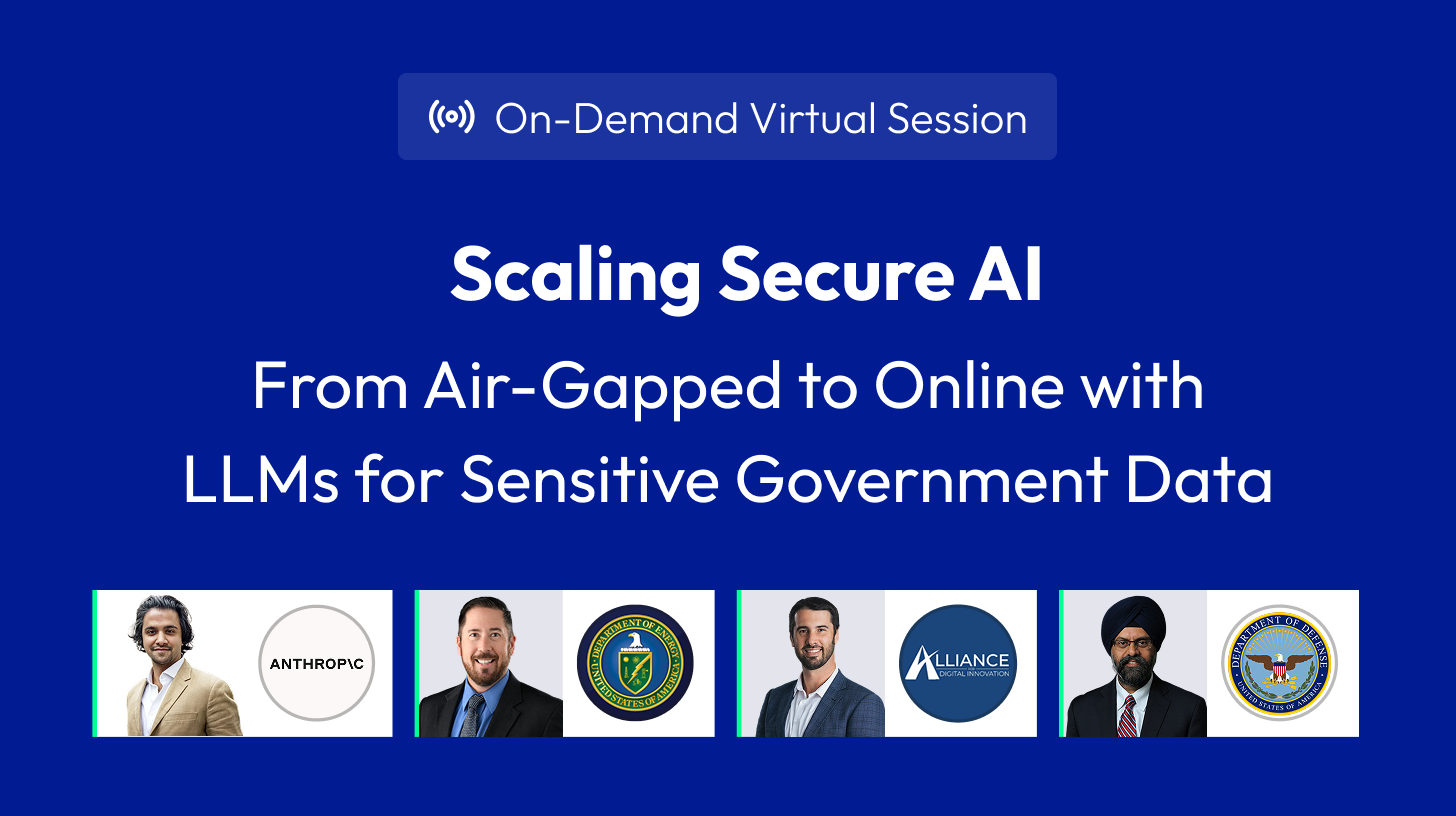
Virtual Session: Scaling Secure AI
Virtual Session: Scaling Secure AI
The pace of government tech modernization is no longer hypothetical. With the launch of the Department of Defense's Software Fast Track (SWFT)initiative, the "Anything-as-a-Service" (XaaS) pilot program, and a wave of FAR reform, 2025 marks a turning point in federal procurement. For SaaS companies that have hesitated to engage with FedRAMP or DISA due to the cost, complexity, or timeline—this is your moment.
The Old Barriers Are Breaking
For years, FedRAMP has been seen as a compliance gate too costly or time-consuming to pass through. Many high-growth SaaS companies, even those with cutting-edge AI, DevSecOps, or zero-trust capabilities, have opted out of the federal market altogether. But now, the risk of not entering the federal space may be greater than the perceived cost of entry.
New guidance from FedRAMP’s Rev 5, transformative changes to significant change processes, and the momentum behind procurement modernization are all aimed at removing bottlenecks. And yet, even with these shifts, navigating the federal compliance maze still requires expertise, infrastructure, and credibility.
Enter Knox: Compliance WithoutCompromise
Knox exists to eliminate the friction between SaaS innovation and government adoption. Through our fully authorized FedRAMP and DISA-compliant boundary, we offer:
- Accelerated ATO access via inheritance and ready-made compliance packages
- Continuous monitoring and remediation as a service, reducing your internal burden
- A vendor-friendly model that slashes timelines from 18-36 months to under 4 months
We’re already powering FedRAMP success for SaaS companies serving theDoD, the U.S. Air Force, and other federal agencies. And we do it without sacrificing your roadmap, agility, or capital.
Why 2025?
Because the stars have aligned
- SWFT is live. The Pentagon wants faster access to innovative tech, and is building processes to support it.
- XaaS pilot programs are expanding. The government is moving from CapEx to OpEx—and SaaS is the model.
- Budgets are shifting. Agencies are under pressure to modernize faster, with less.
- The compliance landscape is evolving. FedRAMP and DISA are both making space for secure-by-design solutions to scale faster.
Don’t Wait to Get Left Behind
We are entering a golden window for market entry. If you're a mission-driven SaaS company with solutions that belong in the hands of warfighters and federal users, Knox is your fastest path to impact.
Let us handle compliance, so you can focus on what you do best: building great software.
Key Highlights
- Federal tech modernization is accelerating with SWFT, XaaS pilots, and FAR reform, creating unprecedented opportunities for SaaS vendors in 2025.
- Traditional FedRAMP barriers—cost, time, and complexity—are being reduced through new Rev 5 guidance and modernization initiatives.
- Knox provides a fully authorized FedRAMP and DISA-compliant boundary that enables vendors to achieve ATO in under four months.
- The Knox platform delivers inherited controls, continuous monitoring, and automated compliance to eliminate friction between innovation and adoption.
- With agencies prioritizing speed, modernization, and secure-by-design solutions, now is the time for SaaS companies to enter the federal market with Knox.
Frequently Asked Questions
1. Why is 2025 a pivotal year for SaaS companies to pursue FedRAMP readiness?
New government initiatives like SWFT, XaaS, and procurement reform have made it easier and faster for SaaS companies to achieve FedRAMP authorization and enter the federal market.
2. How do programs like SWFT and XaaS change federal procurement?
SWFT accelerates software onboarding for the Department of Defense, while XaaS pilots shift agencies toward subscription-based models that favor fast, compliant SaaS adoption.
3. How does Knox simplify the FedRAMP process for SaaS vendors?
Knox provides a pre-authorized FedRAMP and DISA-compliant boundary with built-in inheritance, continuous monitoring, and ready-made compliance packages that shorten timelines to under four months.
4. Why are traditional barriers to FedRAMP compliance disappearing?
Updated FedRAMP guidance, faster change management, and modernization mandates are reducing red tape and enabling vendors to move quickly without excessive cost or complexity.
5. What makes Knox the right partner for SaaS companies in 2025?
Knox combines proven federal cloud expertise with automation, continuous monitoring, and speed to authorization, allowing mission-driven vendors to reach the government market faster and more efficiently.
TL;DR
The federal government is rethinking procurement, with programs like SWFT and XaaS making it easier than ever for SaaS companies to break in. Knox offers a FedRAMP- and DISA-compliant boundary with continuous monitoring, allowing SaaS vendors to achieve authorization in months instead of years. 2025 is the moment to act—because federal buyers are ready, and the door is open.
Learn how Knox can help you go FedRAMP-ready, faster than ever.

Now or Never: Why 2025 Is the Moment to Go FedRAMP-Ready How SWFT, XaaS, and federal IT reform make Knox the right partner at the right time
Now or Never: Why 2025 Is the Moment to Go FedRAMP-Ready How SWFT, XaaS, and federal IT reform make Knox the right partner at the right time
SAN FRANCISCO and NEW YORK — April 24, 2025
Knox Systems and RapidFort are excited to announce a strategic partnership, bringing together two mission-driven teams committed to transforming how secure software reaches the U.S. Government.
By combining Knox’s FedRAMP-ready cloud platform—purpose-built for SaaS vendors—with RapidFort’s runtime attack surface reduction technology, we’re helping modern software companies meet the government's security and compliance requirements faster, more efficiently, and without compromise.
Together, we’re advancing our shared mission: unlocking access to cutting-edge commercial software for government agencies by streamlining compliance and strengthening application security.
“RapidFort’s ability to automatically harden workloads is a game changer for any company targeting FedRAMP,” said Irina Denisenko, CEO of Knox. “They help vendors ship secure software with confidence—faster and with less overhead. We're proud to partner with a team that shares our vision of accelerating access to innovation in government.”
“Knox has reimagined the path to FedRAMP in a way that makes it truly achievable for today’s SaaS vendors,” said Mehran Farimani, CEO of RapidFort. “We’re thrilled to partner with them to make software more secure and more accessible to the agencies that need it most.”
This partnership empowers SaaS vendors to:
- Achieve FedRAMP authorization in record time with Knox
- Secure their workloads and reduce software attack surfaces with RapidFort
- Deliver modern, compliant solutions that meet mission-critical needs
The future of government software is faster, safer, and more open—and we’re proud to be building it together.
Learn more at knoxsystems.com and rapidfort.com.
Knox and RapidFort Partner to Unlock Access to Cutting-Edge Softare for the U.S. Government
Knox and RapidFort Partner to Unlock Access to Cutting-Edge Softare for the U.S. Government
We’re proud to announce that Knox Systems has joined the OpenPolicy ecosystem, a coalition of forward-thinking companies including Wiz, Kiteworks, Armis, and others working to drive innovative cybersecurity, AI and government acquisition policies
As the AI revolution accelerates, the federal government faces a pivotal moment: adopt faster, smarter technologies or risk falling behind.Modernization is no longer a long-term goal. It’s an urgent priority. Agencies need secure, compliant pathways to adopt commercial innovation, especiallyAI-driven solutions, without years of red tape. Innovators and policy makers need to work closely together.
“AI is reshaping every industry, and the public sector is no exception,” said Irina Denisenko, CEO of Knox. “Knox exists to make it easy for innovative SaaS and AI vendors to serve government missions securely and at speed. JoiningOpenPolicy allows us to align our development and GTM to emerging policy and advance that mission alongside other leaders committed to driving thoughtful cybersecurity policies and getting cutting-edge tech into the hands of agencies who need it most.”
“The government can’t afford to get left behind in the AI era,” said Amit Elazari, CEO of OpenPolicy. “Knox brings deep FedRAMP and infrastructure expertise to the network, helping commercial companies overcome the compliance and procurement hurdles that have long slowed public sector innovation.”
Together, Knox and OpenPolicy are:
● Unlocking access to secure, compliant cloud infrastructure for AI and SaaS
● Helping federal buyers adopt commercial innovation faster
● Enabling a more efficient, mission-driven government powered by modern tools
This partnership is a leap forward for government IT, and a step closer to making AI and advanced software truly accessible across the public sector.
Learn more at knoxsystems.com and openpolicy.co.
Frequently Asked Questions
1. What is OpenPolicy and why did Knox join it?
OpenPolicy is a coalition of technology leaders working to modernize government cybersecurity and AI adoption. Knox joined to help accelerate secure, compliant access to innovative software across federal agencies.
2. How does the Knox and OpenPolicy partnership benefit the U.S. government?
The partnership streamlines government access to commercial AI and SaaS solutions by removing compliance and procurement barriers that slow modernization.
3. What role does Knox play within the OpenPolicy ecosystem?
Knox contributes its expertise in FedRAMP authorization, infrastructure automation, and compliance frameworks, enabling vendors to deploy secure, government-ready solutions faster.
4. Why is this collaboration important for federal AI adoption?
As agencies race to integrate AI, the partnership ensures they can do so securely and efficiently while aligning with evolving cybersecurity and acquisition policies.
5. How will this partnership impact government IT modernization?
By combining Knox’s secure cloud infrastructure with OpenPolicy’s policy innovation network, agencies gain faster access to cutting-edge AI and SaaS technologies that support mission success.

Knox Joins OpenPolicy to Accelerate Government Access to Cutting-Edge Software and AI
Knox Joins OpenPolicy to Accelerate Government Access to Cutting-Edge Software and AI
(Spoiler: Yes, If They Want Federal $$)
When early-stage companies talk about product-market fit, they’re usually thinking about commercial buyers—not the U.S. federal government. And that’s a mistake.
Because if your startup is building a SaaS product with security, scale, and potential for critical infrastructure use—there’s a $100B+ federal IT market waiting for you. But there’s a catch, and its name is FedRAMP.
The Compliance Roadblock That Scares Startups Off
FedRAMP (the Federal Risk and Authorization Management Program) is the mandatory security framework for any cloud provider selling to the federal government. It’s notoriously complex, expensive, and slow—think 3–5 years and $3M+ slow.
So most startups—understandably—assume it’s something to “worry about later.”
But here’s the twist: by the time you're ready, it's often too late.
If you wait until a federal opportunity lands in your inbox, and you're not FedRAMP-compliant, the deal is already slipping away.
Flip the Script: Compliance as a Go-to-Market Advantage
This is exactly where Knox Systems comes in.
We built the first FedRAMP-compliant cloud platform purpose-built for SaaS vendors. With Knox, startups can become FedRAMP-ready in just 90 days, at 90% lower cost, and without needing your own agency sponsor.
That means you don’t have to delay your roadmap, hire a team of compliance specialists, or containerize your architecture just to access federal buyers. We meet you where you are—whether you’re running monoliths or microservices.
Why Startups Should Absolutely Care
Let’s get specific. Here’s why your startup should prioritize FedRAMP early:
- Revenue Diversification: Government contracts are stable, high-value, and long-term.
- Faster Sales Cycles: Pre-authorized platforms like Knox let you say yes to buyers with short timelines.
- Increased Valuation: Investors love startups with public sector traction and regulatory readiness.
- Market Differentiation and Competitive Advantage: Most startups aren’t FedRAMP-compliant. You’ll stand out immediately.
- Security Maturity: Even beyond federal sales, FedRAMP alignment improves your trust posture with all enterprise buyers.
Frequently Asked Questions
1. Why should startups care about FedRAMP compliance early on?
FedRAMP compliance opens access to the $100B+ federal IT market, giving startups a competitive edge with secure, compliant solutions that attract long-term government contracts.
2. What makes FedRAMP challenging for early-stage SaaS companies?
The traditional FedRAMP process is costly and time-consuming, often requiring years and millions of dollars to complete, which discourages many startups from pursuing it early.
3. How does Knox help startups achieve FedRAMP readiness faster?
Knox provides a pre-authorized, FedRAMP-compliant infrastructure that helps startups become audit-ready in just 90 days, at 90 percent lower cost and without an agency sponsor.
4. How can FedRAMP readiness improve a startup’s market position?
Achieving readiness signals maturity and security, improves investor confidence, accelerates government sales, and enhances credibility with enterprise buyers.
5. What happens if startups wait too long to pursue FedRAMP?
Delaying FedRAMP alignment can cause missed federal opportunities, as most agencies require compliance before procurement begins, making late readiness a costly setback.
TL;DR
Startups shouldn’t wait until they’re “ready” to think about FedRAMP. If federal contracts are even remotely in your vision—Knox can get you there faster, cheaper, and smarter than you ever thought possible.
Let your competitors ignore FedRAMP. You’ll be winning contracts while they’re Googling “ATO meaning.”

Should Startups Care About FedRAMP?
Should Startups Care About FedRAMP?
Part 2: Toward Continuous Compliance Quantifying Risk with Bayes and Capturing Evidence in a Security Ledger
By Chris Johnson, CTO of Knox Systems
In Part 1, we introduced the Security Ledger—a real-time, tamper-proof system that reframes FedRAMP compliance as a probabilistic, continuously updated measure, not a static report. Now, in Part 2, we go under the hood.
We'll show how Bayesian inference, log-likelihood ratios (LLRs), and ledger-based transparency work together to produce a living risk engine—one that is inspectable, auditable, and mathematically defensible.
And yes, we brought code and real data.
From Binary to Bayesian: Probabilistic Assurance of Control Effectiveness
FedRAMP controls aren’t simply "on" or "off." Their effectiveness shifts with context, evidence, and time. So we treat each control as a probabilistic hypothesis:
P(Control is Effective | Evidence)
This lets us reason continuously over real-world telemetry: IAM logs, patch scans, drift reports, vulnerability findings, and more. The system updates confidence scores in real time—no waiting for annual audits.
Step 1: Assigning Prior Probabilities
Every control begins with a prior belief—a starting point for how likely it is to be effective. These priors are informed by:
- Control category (e.g. access control vs. incident response)
- Historical failure rates
- Threat modeling and exploit severity
- Complexity and likelihood of drift
Example:
These priors are tunable and evolve with new deployments and observed outcomes.
Step 2: Defining Evidence and LLRs
We define discrete evidence events—findings that either increase or decrease confidence in a control. Each is assigned a log-likelihood ratio (LLR):
log(posterior odds) = log(prior odds) + Σ LLRs
This additive update makes real-time scoring efficient and interpretable.
Example for SI-2 (Flaw Remediation):
LLRs are computed based on empirical data and mapped to actual telemetry triggers.
Real-World Example: AC-2 (Account Management)
From our working model:
- Risk Scenario: A former employee's account is still active and exploited
- P(A): 0.3 (probability of compromise if ineffective)
- Evidence LLRs:
- Account review overdue: -1.2
- No MFA for privileged accounts: -1.5
- Active Directory logs confirm removal: +1.0
- Account review overdue: -1.2
This model is applied to all 323 FedRAMP Moderate controls using structured data and open analysis:
🔗 GitHub Repo: Knox-Gov/nist_bayes_risk_auto
Prioritizing What Matters: The High-Risk Controls
Using this model, we ranked all FedRAMP Moderate controls by severity and potential impact.
The Top 11 High-Risk Controls stood out due to:
- High exploitation risk
- Poor observability without targeted telemetry
- Broad system impact if compromised

These controls form the foundation of our telemetry blueprint—what every system should continuously monitor and score.
Step 3: Continuous Confidence Calculation
Every time Prometheus scrapes a new metric:
- Convert prior to log-odds
- Add up matching LLRs
- Convert back to a probability using the logistic function:
P = 1 / (1 + e^(-log odds))
This produces a dynamic confidence score for each control, updated in real time as evidence changes.
Step 4: Writing to the Security Ledger (Amazon Aurora PostresSQL)
Every update—control ID, evidence, LLRs, and confidence score—is appended as a new, immutable revision to Amazon Aurora PostresSQL, our Security Ledger backend.
Each record includes:
- Control ID
- Timestamps
- Prior and posterior probabilities
- Evidence names + timestamps
- LLR sum
- Operator ID (if manually overridden)
This creates a cryptographically verifiable audit trail. Auditors and agencies can trace any score, see what changed, and confirm whether evidence was valid and in-scope.
Why This Must Be Open
If machines are going to tell us when a control is “healthy,” then the logic behind it must be transparent.
That’s why we’re open-sourcing:
- The LLR control dictionary
- Control-to-evidence mappings
- Assumptions and source data
Just like LLMs disclose model weights and benchmarks, compliance logic must be explainable, auditable, and improvable by the community.
Compliance is too important to be a black box.
Recap: What We’ve Built
- Bayesian engine for dynamic scoring
- Prior and evidence probabilities for every FedRAMP Moderate control
- Identification of top 11 high-risk controls
- Immutable compliance ledger in Amazon Aurora PostresSQL
- Prometheus telemetry mapping in progress
- GitHub: Open LLR control spec
Frequently Asked Questions
1. How does Bayesian inference improve FedRAMP compliance monitoring?
Bayesian inference continuously updates each control’s confidence level based on real-time evidence, allowing compliance teams to quantify risk dynamically rather than rely on periodic assessments.
2. What role does AI play in continuous compliance for SaaS vendors?
AI automates evidence collection, calculates log-likelihood ratios (LLRs) or similar statistical indicators, and updates control probabilities in real time—transforming compliance from static documentation into a living risk model.
3. How does Knox use telemetry tools like Prometheus for compliance tracking?
Knox leverages Prometheus to scrape and store live metrics tied to FedRAMP controls, enabling continuous monitoring and automated confidence score updates within its Security Ledger.
4. Why is transparency important in AI-driven compliance systems?
Open-source models and transparent model reference dictionaries or explainability maps ensure that AI logic behind compliance scoring remains auditable, explainable, and trustworthy for agencies and auditors.
5. How does the Security Ledger ensure auditability in real time?
Every compliance update is immutably logged in a managed PostgreSQL-compatible database (such as Amazon Aurora) with timestamps, evidence data, and probability revisions—creating a cryptographically verifiable audit trail.
Coming in Part 3:
We’ll go deeper into instrumentation—mapping every FedRAMP Moderate control to Prometheus-compatible metrics and redefining the role of the 3PAO as a real-time verifier of system integrity.
The future of trust is continuous, explainable, and open. Let’s build it together.

Part 2: Toward Continuous Compliance Quantifying Risk with Bayes and Capturing Evidence in a Security Ledger
Part 2: Toward Continuous Compliance Quantifying Risk with Bayes and Capturing Evidence in a Security Ledger
Part 3: Toward Continuous Compliance: Open Telemetry, Control Coverage, and the Role of the 3PAO
By Casey Jones, Chief Architect of Knox Systems
In Part 1, we proposed the concept of a Security Ledger: a cryptographically verifiable system of record for compliance that updates continuously based on real-time evidence. In Part 2, we detailed how risk-adjusted confidence scores can be calculated using Bayes’ Theorem and recorded immutably in LedgerDB.
In this third and final part of the series, we focus on the next frontier: standardizing telemetry coverage across controls, open-sourcing the control-to-evidence map, and redefining the role of the 3PAO to ensure integrity in a continuous compliance world.
Building the Open Compliance Telemetry Layer
In order for the Security Ledger to be trustworthy, it must be fed with comprehensive, observable evidence across the full FedRAMP boundary. That means creating a control-to-telemetry map that:
- Defines what evidence types are relevant for each FedRAMP control
- Maps those to Prometheus-compatible metrics
- Defines evidence freshness, decay windows, and severity
- Supports automated generation of control coverage reports
At Knox, we’re working to open-source this telemetry model so that:
- Every stakeholder (CSPs, 3PAOs, agencies) understands the required observability footprint
- No one is guessing what counts as evidence
- The community can contribute new detectors and mappings
Just like OWASP standardized threat awareness, we need a COTM — Common Observability for Trust Model.
Coverage Is the Control: Incomplete Telemetry ≠ Compliance
In the current FedRAMP model, it's possible to "pass" controls without actually observing the whole system. But in a ledger-based model, telemetry gaps are violations.
Examples of common pitfalls:
- Only scanning certain subnets or environments (e.g., “we forgot our staging VPN”)
- Disabling or misconfiguring logging for noisy subsystems
- Letting vulnerability scan coverage drop below 100% of the boundary
- Using static evidence from prior scans without freshness guarantees
- Allowing Prometheus exporters to fail silently without alerting
In a real-time, risk-scored model, all of these create confidence decay—and should result in lowered scores or even automated POA&M creation.
The New Role of the 3PAO: Continuous Verifier of Scope, Integrity, and Fair Play
In a world where compliance is driven by real-time evidence, the Third Party Assessment Organization (3PAO) becomes more critical—not less.
But their role shifts from "point-in-time validator" to continuous integrity checker.
Here’s what the 3PAO’s job looks like in a Knox-style system:
1. Boundary Enforcement
- Validate that all components within the FedRAMP boundary are included in telemetry coverage
- Detect "convenient omissions" (e.g., shadow servers, unmonitored edge cases)
2. Signal Integrity
- Confirm that metrics flowing into the Security Ledger are accurate, unmodified, and traceable
- Review sampling intervals, evidence freshness, and exporter health
- Perform forensic verification of selected evidence streams
3. Anti-Fraud Auditing
- Detect signs of foul play or negligence, such as:
- Turning off scanning before high-risk deploys
- Creating “burner” environments that avoid monitoring
- Suppressing alert signals or log forwarders
- Replaying old data to simulate real-time telemetry
4. Ledger Auditing
- Verify the cryptographic chain of trust in the ledger system (e.g., via Amazon Aurora PostresSQL or blockchain)
- Ensure control scores are only adjusted by valid evidence with assigned LLRs
- Validate that manual overrides are documented and signed
In this model, the 3PAO becomes the trust anchor of the continuous compliance pipeline.
They’re not just checking boxes—they’re inspecting the wiring.
Transparency Through Community
All of this only works if the model is open:
- The LLRs for each control must be public
- The control-to-metrics map must be versioned and community-governed
- The Security Ledger’s core schema must be inspectable and verifiable
Just as large language models opened their weights to gain credibility, compliance models must open their logic. Closed-source compliance logic is a liability.
The Future of FedRAMP Is Verifiable, Transparent, and Alive
We’re not just building for ATOs—we’re building for continuous trust.
FedRAMP’s future lies in:
- Real-time metrics
- Probabilistic control scoring
- Immutable audit trails
- Open-source control logic
- 3PAOs as continuous validators, not just periodic checkers
At Knox, we’re committed to that shift—because trust shouldn’t expire every 12 months.
Frequently Asked Questions
1. What is the purpose of open telemetry in continuous FedRAMP compliance?
Open telemetry ensures every system component is continuously monitored through streaming or real-time metrics, removing blind spots and enabling transparent, evidence-based compliance tracking.
2. How does AI improve control coverage across the FedRAMP boundary?
AI analyzes telemetry data, identifies coverage gaps, and recalculates confidence scores automatically when evidence decays or monitoring fails.
3. Why is incomplete telemetry considered a compliance risk?
Missing or outdated telemetry reduces visibility into system integrity, lowers confidence scores, and indicates that certain controls may not be fully effective.
4. How is the role of the 3PAO evolving in AI-driven compliance systems?
3PAOs are shifting from one-time assessors to ongoing integrity verifiers who monitor evidence streams, validate ledger accuracy, and detect fraudulent or incomplete data.
5. Why must continuous compliance models be open-source and transparent?
Transparency builds trust because open-sourcing model dictionaries or explainability maps, telemetry mappings, and ledger schemas ensures that compliance logic is verifiable and auditable.

Part 3: Toward Continuous Compliance: Open Telemetry, Control Coverage, and the Role of the 3PAO
Part 3: Toward Continuous Compliance: Open Telemetry, Control Coverage, and the Role of the 3PAO
FedRAMP Needs a Security Ledger—Not Just a Checklist, Part 1
By Irina Denisenko, CEO of Knox Systems
FedRAMP has long set the benchmark for cloud security compliance in the public sector. But its current structure—based on periodic assessments and voluminous documentation—struggles to reflect real-time risk and operational truth. What’s missing is not just a better checklist. What’s missing is a Security Ledger.
Just as blockchain introduced the concept of an immutable ledger to prove ownership in crypto, a Security Ledger would establish a tamper-proof, transparent record of an organization’s control posture: Are you compliant or not—and with what level of confidence?
But unlike public blockchains, this ledger isn’t visible to the world. Access is strictly limited to the parties who need to validate the system's security:
- The Cloud Service Provider (CSP)
- The consuming Agency(ies)
- The authorized Third-Party Assessors (3PAOs)
No one else. This is a permissioned ledger, designed for shared trust between verified participants, not public exposure.
But security controls aren't binary. In practice, compliance lives on a spectrum. Some controls are fully satisfied, others only partially. Evidence decays. Systems drift. Risk must be constantly re-evaluated. That’s where Bayesian reasoning comes in. By applying Bayes' Theorem to control assessment—drawing from the excellent work by Stephen Shaffer—we can quantify our belief in the effectiveness of each control and update it continuously based on new observations.
So how do we build this?
The answer lies in Prometheus—the open-source monitoring system that already powers observability at scale across the cloud. Prometheus is built for high-volume, time-series data and excels at continuously scraping, storing, and querying metrics. It's an ideal foundation for a risk-adjusted compliance telemetry layer.
Imagine a system where every FedRAMP control has a corresponding set of observable metrics—scraped, labeled, and stored over time using Prometheus. These metrics feed into a Bayesian model that computes dynamic confidence scores for each control. When paired with a cryptographically verifiable ledger system, this becomes a living, breathing compliance profile: a Security Ledger that is transparent, provable, and grounded in operational reality.
At Knox, we’re building toward this future—one where compliance is not a static report, but a living signal. Powered by open standards like Prometheus and informed by probabilistic models, this is how we transform trust: from paperwork to math.
Frequently Asked Questions
1. What is a Security Ledger in the context of FedRAMP compliance?
A Security Ledger is a permissioned, tamper-resistant record of an organization’s control posture, providing real-time visibility into compliance confidence rather than relying on static documentation.
2. How does AI enhance a Security Ledger for continuous compliance?
AI models use Bayesian reasoning to analyze evolving data from systems like Prometheus, updating confidence levels for each control as new security evidence emerges.
3. Why is real-time telemetry better than checklist-based compliance?
Continuous telemetry powered by AI and observability tools captures live control data, giving agencies a dynamic picture of security health instead of outdated audit snapshots.
4. How can Bayesian inference improve FedRAMP control assessment?
By applying Bayes’ Theorem, AI can continuously quantify the likelihood that a control is still operating as intended, creating a measurable, evolving trust signal for assessors and agencies.
5. What technologies power Knox’s vision for a Security Ledger?
Knox leverages open-source systems like Prometheus for time-series monitoring, Bayesian models for risk adjustment, and cryptographically verifiable storage for auditable compliance.
Stay tuned for Part 2, where our CTO will deep-dive into how Knox envisions the mechanics behind risk-adjusting control confidence using Bayesian inference—and how we ensure the immutability and auditability of that data using Amazon Aurora PostresSQL. We’ll walk through how likelihood ratios are assigned, how evidence is evaluated in real time, and why open-sourcing the control model is essential to building trust in the next era of FedRAMP.

Part 1: FedRAMP Needs a Security Ledger—Not Just a Checklist
Part 1: FedRAMP Needs a Security Ledger—Not Just a Checklist
We’re proud to announce our $6.5 million seed round raise. TechCrunch covered the news this morning:
Knox, named after a giant gold storage fort in Kentucky, essentially provides a compliance management platform via a managed cloud that customers can connect their codebase to. The company's software runs a continuous series of tests and audits to identify where the customer's infrastructure, code and security controls are falling short of FedRAMP standards, and either remediates those issues itself or flags them to the customer. It also offers some non-software tools to track and verify policies like personnel training and vendor management.
We’re solving one of the most urgent problems in GovTech: how to safely accelerate the adoption of AI and cloud software at scale.
The investment, led by Felicis with participation from Ridgeline and FirsthandVC, will help us unlock thousands of secure, AI-powered SaaS apps for government and DoD use.
We’re on a mission to bring the best technology innovation to our government. Technologies such as AI can drive transformational growth and productivity gains, which is critical for the United States to stay competitive as the global leader. Knox is working closely with key agencies to pioneer a secure AI infrastructure model that enables access to these applications without sacrificing control or security.
Our AI-powered, turnkey platform offers a faster, more agile path to FedRAMP authorization by automating manual processes while also contextualizing decades of operational know-how into digital expert agents.
We’re working closely with the U.S. government to pioneer a secure AI infrastructure model that enables access to SaaS applications without sacrificing control or security. Knox supports all three major hyperscalers and is trusted by more than 15 federal and defense agencies, including the Department of Homeland Security, the Treasury Department, and the Marines.
Thanks again to Viviana Faga and Nancy Wang at Felicis, Ben Walker at Ridgeline and Simon Chan at FirsthandVC for their support as we build.
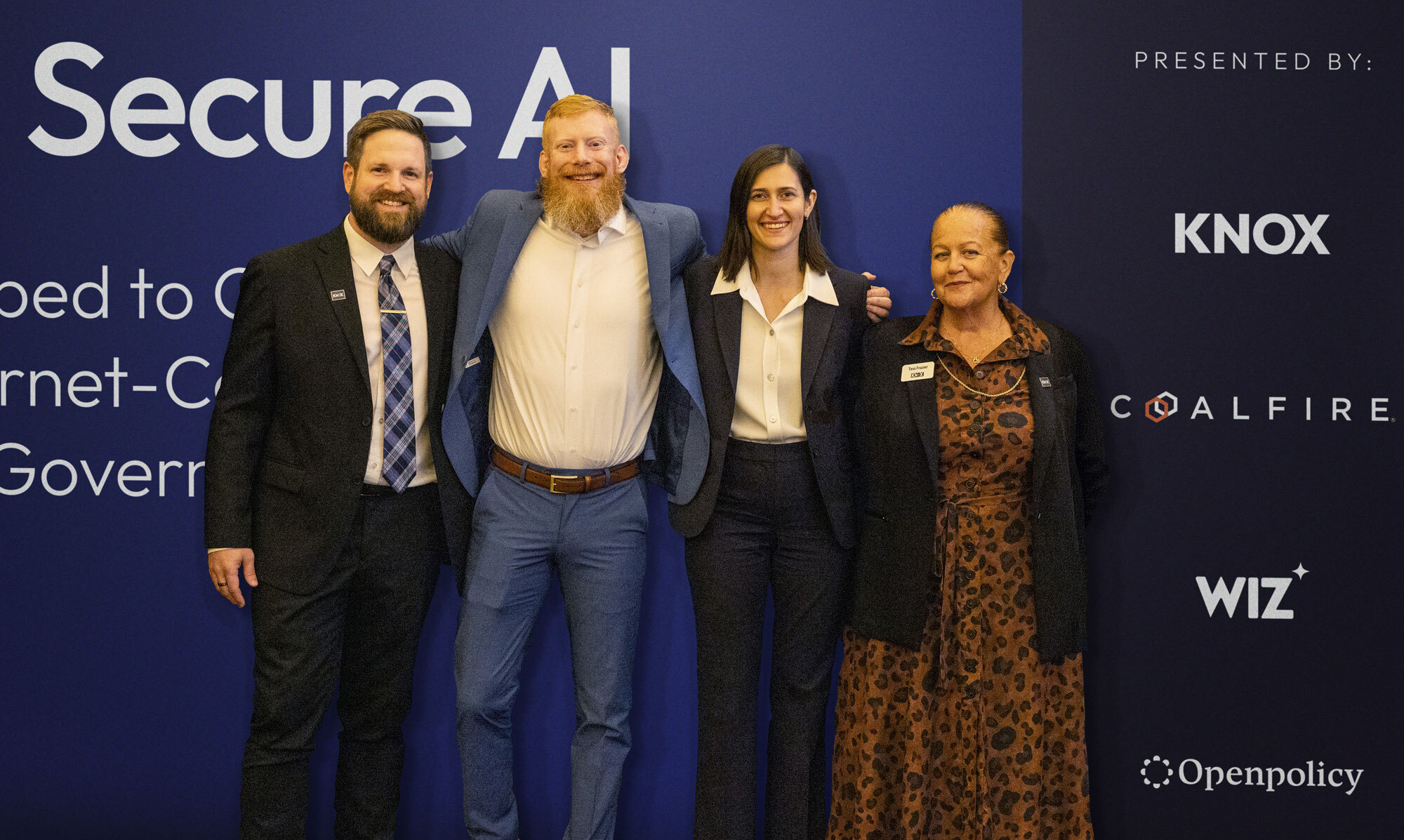
Knox Raises Seed Round to Accelerate AI and SaaS Adoption by the Federal Government and Department of Defense
Knox Raises Seed Round to Accelerate AI and SaaS Adoption by the Federal Government and Department of Defense
Knox today announced that David Epperson has joined the company’s Federal Advisory Board. A veteran federal technology leader, Epperson previously served as Deputy Chief Information Officer to the Executive Office of the President (EOP), and as the first Chief Information Officer (CIO) and Chief Information Security Officer (CISO) of the Cybersecurity and Infrastructure Security Agency (CISA). He is currently the Chief Information Security Officer (CISO) at H2O.ai.

With hands-on experience standing up enterprise cyber programs, guiding White House transitions, and operationalizing risk management at national scale, Epperson will advise Knox on product strategy, partnerships, and adoption patterns that matter most to federal leaders, particularly around secure AI, identity-centric controls, and compliance in complex multi-cloud environments.
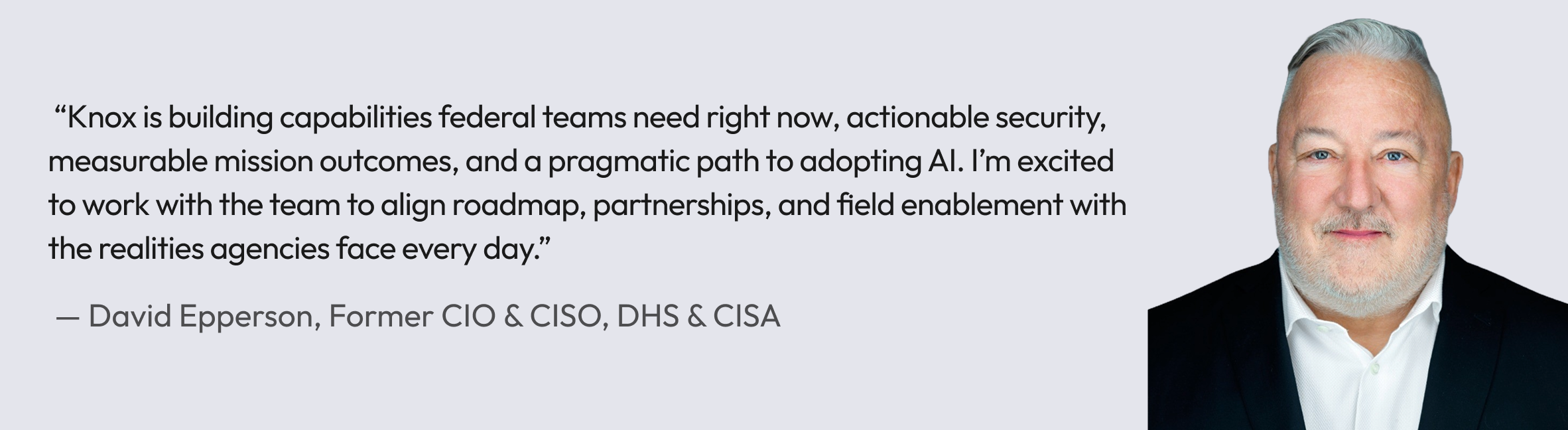
About David Epperson
David Epperson is a nationally recognized technology leader with service spanning the White House and the Department of Homeland Security. He served as Deputy CIO to the Executive Office of the President, and became the inaugural CIO/CISO of CISA, where he helped establish enterprise IT and cybersecurity foundations. He is currently Chief Information Security Officer at H2O.ai, where he focuses on securing AI systems and data across critical missions.
About Knox
Knox helps SaaS companies achieve FedRAMP in 90 days or less, at 90% of the traditional cost.
We run the largest FedRAMP Authorized managed cloud platform in the world, bringing a decade-long track record of secure and compliant operations.
Trusted by Adobe since 2014, Knox streamlines the path to FedRAMP authorization, enabling vendors to achieve FedRAMP in just 90 days across AWS, Azure, and GCP.

David Epperson Joins Knox Federal Advisory Board
David Epperson Joins Knox Federal Advisory Board
Knox Systems today announced the appointment of Carrie Lee, Former Chief Product Officer and Deputy Chief Information Officer for the Department of Veterans Affairs (VA), to its Federal Advisory Board.
A nationally recognized leader in technology modernization, Ms. Lee oversaw Product Delivery for one of the government's largest and most complex IT enterprises. At the VA, she helped drive some of the agency's most ambitious modernization efforts- from low-code and SaaS adoption to the first continuous Authorization to Operate (ATO) process in a civilian agency, cutting compliance timelines from more than a year to just sixty days.
As part of the Knox Federal Advisory Board, Ms. Lee will contribute her expertise in federal IT transformation, data modernization, and secure AI enablement. The Board brings together senior leaders from defense, civilian, and technology sectors to advise Knox on policy, compliance, and mission-driven innovation across FedRAMP, NIST, and DoW standards.

Her appointment follows the recent addition of David Epperson, former CIO of the Cybersecurity and Infrastructure Security Agency (CISA) and former CISO for the Department of Homeland Security, further strengthening the Board's deep federal leadership bench. Together, these appointments underscore Knox's commitment to helping agencies accelerate cloud and AI adoption without compromising security or compliance.
About Knox
Knox helps SaaS companies achieve FedRAMP in 90 days or less, at 90% of the traditional cost.
We run the largest FedRAMP Authorized managed cloud platform in the world, bringing a decade-long track record of secure and compliant operations.
Trusted by Adobe since 2014, Knox streamlines the path to FedRAMP authorization, enabling vendors to achieve FedRAMP in just 90 days across AWS, Azure, and GCP.
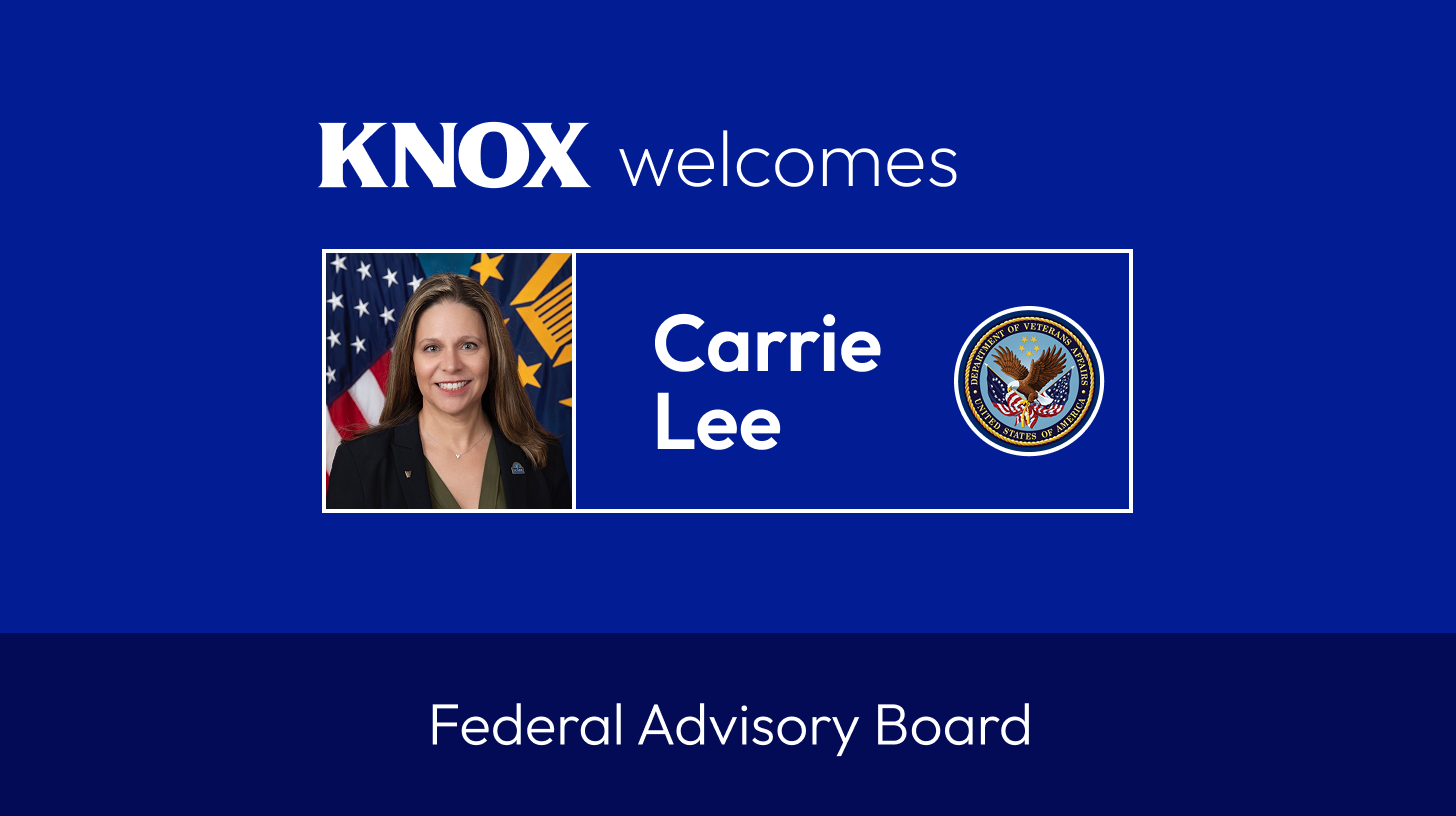
Carrie Lee Joins Knox Federal Advisory Board
Carrie Lee Joins Knox Federal Advisory Board
Knox Systems today announced that Zscaler Public Sector CTO and a former Deputy Chief Technology Officer and Deputy Chief Artificial Intelligence Officer from within the Department of Homeland Security (DHS), Chad Tetreault, has joined the company’s Federal Advisory Board.
A proven technology leader and AI strategist, Tetreault has spent his career bridging the gap between emerging technology and mission impact. At DHS, he led the design and deployment of proprietary AI solutions that modernized Immigration services, streamlined data operations, and advanced the department’s role as a leader in responsible AI innovation. His appointment strengthens Knox’s mission to help agencies accelerate cloud and AI adoption with the compliance, speed, and resilience required of federal systems.

At Zscaler, Tetreault leads public sector AI strategy and governance, helping highly regulated environments adopt and defend next-generation AI capabilities. He also serves on the MIT Gen AI Global leadership team as Deputy Co-Lead of the Agent Dev Department, focused on democratizing AI innovation worldwide.
Tetreault continues to define unified technology strategies, integrate data and engineering across mission systems, and mentor high-performing technical teams that deliver. His work consistently emphasizes innovation with accountability - ensuring AI and analytics can drive measurable outcomes without compromising compliance or security.
The Knox Federal Advisory Board brings together senior leaders from defense, civilian, and technology sectors to advise on emerging policy, compliance, and modernization strategies aligned with FedRAMP, NIST, and DoW frameworks. Tetreault’s appointment follows recent additions including David Epperson, former Deputy CIO of the Executive Office of the President and former Deputy CIO and CISO of the Cybersecurity and Infrastructure Security Agency, and Carrie Lee, Deputy CIO of the Department of Veterans Affairs - expanding Knox’s leadership bench across AI, cybersecurity, and federal IT transformation.
About Knox
Knox helps SaaS companies achieve FedRAMP in 90 days or less, at 90% of the traditional cost.
We run the largest FedRAMP Authorized managed cloud platform in the world, bringing a decade-long track record of secure and compliant operations.
Trusted by Adobe since 2014, Knox streamlines the path to FedRAMP authorization, enabling vendors to achieve FedRAMP in just 90 days across AWS, Azure, and GCP.

Chad Tetreault Joins Knox Systems Federal Advisory Board
Chad Tetreault Joins Knox Systems Federal Advisory Board
Key Highlights
- Knox proudly sponsored the GovCIO Media & Research Federal IT Efficiency Summit and Flywheel Awards in Washington, D.C.
- The event gathered federal and DoW leaders driving government transformation through innovation, automation, and bold action.
- Key speakers included Rep. Pete Sessions, Co-Chair of the Congressional DOGE Caucus; Robert C., CIO of CISA; and Pritha Mehra, CIO of USPS.
- The Flywheel Awards celebrated rising stars, digital transformers, innovation champions, change drivers, and workforce enablers across U.S. federal agencies.
- Knox reaffirmed its mission to support modernization and secure cloud adoption across the federal government.
Knox Systems was honored to sponsor the Federal IT Efficiency Summit and Flywheel Awards, hosted by GovCIO Media & Research. The event brought together the nation’s top federal and DoD leaders to highlight how technology and innovation are shaping the future of government.
Why was Knox’s sponsorship of the Federal IT Efficiency Summit significant?
It set the stage for a new era of efficiency in federal IT. It aligns with Knox’s mission of accelerating secure cloud and SaaS adoption with the broader federal IT agenda. As they capitalize on efficiency, resilience, and modernization, Knox’s support helps amplify the voices of leaders who are driving digital transformation across government.
Held on July 10, the Federal IT Efficiency Summit convened more than 300 attendees to discuss the evolving challenges and opportunities in federal IT. Distinguished speakers included Congressman Pete Sessions, CISA CIO Robert C., and USPS CIO Pritha Mehra.
A highlight of the summit was the Federal IT Efficiency Flywheel Awards, recognizing innovators across five categories: Rising Star, Digital Transformer, Innovation Champion, Change Driver, and Workforce Enabler. Finalists represented agencies such as the FAA, Department of State, DOJ, Department of Labor, IRS, CBP, HUD, NIH, Space Force, and the Veterans Benefits Administration.
By sponsoring this event, Knox reinforced its position as a trusted partner for agencies seeking to modernize securely with cloud-based solutions. Such trust is built on Knox’s track record of helping SaaS vendors achieve FedRAMP authorization in just 90 days- echoing the summit’s theme of greater efficiency in government IT.
The Federal IT Efficiency Summit and Flywheel Awards celebrated the innovators reshaping the future of federal IT. As a proud sponsor, Knox Systems continues to support the community of leaders and agencies that are driving efficiency, security, and modernization across government.
Continue your journey with Knox:
- 📖 Read more on the Knox Blog
- 🔗 Follow us on LinkedIn
- 🚀 Book a Demo to accelerate your federal cloud journey

Knox Sponsors the Federal IT Efficiency Summit and Flywheel Awards
Knox Sponsors the Federal IT Efficiency Summit and Flywheel Awards
Key Highlights
- Knox Systems was selected to demo KnoxAI, its AI-powered FedRAMP Auditor, at this month’s FedRAMP 20x working group.
- In partnership with Adobe, Wiz, Drata, and Coalfire, KnoxAI validated evidence in under 90 minutes with no manual sampling or delays.
- KnoxAI, which has been trained on 10+ years of audit data, automates control validation, maps to KSIs, and cuts manual effort by 100%.
- Already deployed across the U.S. Navy, DHS, and the U.S. Treasury, KnoxAI is bringing true continuous monitoring into practice.
- Knox is helping advance the future of FedRAMP by enabling autonomous, continuous compliance.
Continuous monitoring has long been the ambition of FedRAMP, but manual processes and delayed evidence collection have slowed progress. At this month’s FedRAMP 20x working group, Knox Systems demonstrated how KnoxAI is making continuous and automated compliance a reality today.
Why is KnoxAI’s demo at FedRAMP 20x significant?
It proves that control validation, evidence generation, and audit verification can all be automated. Knox AI removes manual bottlenecks and sets the foundation for continuous, automated monitoring across federal cloud environments.
As part of the Phase 1 pilot, Knox Systems scanned Adobe Connect’s infrastructure-as-code (IaC) with KnoxAI, generated machine-readable JSON evidence, and had it validated by Coalfire audit data: all in less than 90 minutes. Working alongside Wiz for live risk scanning and Drata for non-code controls, Knox showcased a fully autonomous workflow: no manual evidence pushes, no sampling, and no lag.
The implications are clear. By cutting manual compliance effort by 99.99%, KnoxAI redefines how agencies and vendors approach FedRAMP authorization and ongoing monitoring. Already in use across the U.S. Navy, Department of Homeland Security, and Department of the Treasury, KnoxAI is accelerating the government’s path to true continuous automated monitoring, aligning compliance with operational speed.
The FedRAMP 20x community is shaping the future of compliance, and KnoxAI is already delivering it. By combining automation, AI, and a decade of federal audit expertise, Knox is enabling agencies and vendors to meet the highest standards of security, without slowing down.
Continue your journey with Knox:
- 📖 Read more on the Knox Blog
- 🔗 Follow us on LinkedIn
- 🚀 Book a Demo to accelerate your federal cloud journey

KnoxAI Showcased at FedRAMP 20x Working Group
KnoxAI Showcased at FedRAMP 20x Working Group
Key Highlights
- Tovuti LMS achieved FedRAMP authorization in only 45 days by partnering with Knox Systems.
- The authorization enables Tovuti to securely serve U.S. federal agencies and contractors with its AI-powered LMS.
- Knox’s FedRAMP-ready boundary eliminates the need for agency sponsorship, reducing costs by up to 90%.
- With fewer than 500 of 30,000+ SaaS vendors achieving FedRAMP, this milestone cements Knox as a clear differentiator
- This partnership positions Tovuti to expand across federal, state, and defense organizations, equipping workforces with scalable training and compliance capabilities
Modernizing learning and workforce development in the federal sector requires technology that is both innovative and compliant. By achieving FedRAMP authorization in just 45 days, Tovuti LMS, powered by Knox Systems, has unlocked secure, AI-driven learning capabilities for government agencies.
Why is Tovuti’s FedRAMP authorization such a breakthrough?
It proves that SaaS vendors don’t need years and millions of dollars to access the federal market. With Knox, Tovuti achieved full compliance in 45 days, setting a new benchmark for speed, cost-efficiency, and innovation.
The traditional FedRAMP process can stretch over three years and cost upwards of $3 million-an obstacle that leaves thousands of SaaS vendors locked out of the federal market. With Knox’s FedRAMP-ready boundary and AI-powered compliance automation, Tovuti bypassed those barriers, achieving full authorization in record time.
Now, Tovuti can deliver its award-winning platform: including AI-powered content creation, prebuilt course libraries, and interactive learning tools, to U.S. government agencies. This capability positions federal organizations to modernize training, accelerate onboarding, and build future-ready teams. The partnership between Knox and Tovuti highlights how secure cloud infrastructure and next-generation SaaS can transform public sector operations.
Tovuti’s rapid FedRAMP authorization is more than a milestone: it’s a model for how SaaS innovation can meet government security requirements without delay. By leveraging Knox’s secure federal cloud, Tovuti is now positioned to empower agencies nationwide with modern, AI-driven learning solutions, delivering both compliance and impact at mission speed.
Continue your journey with Knox:
- 📖 Read more on the Knox Blog
- 🔗 Follow us on LinkedIn
- 🚀 Book a Demo to accelerate your federal cloud journey

Tovuti LMS Achieves FedRAMP Authorization in Just 45 Days with Knox, Unlocking Modern Learning Tech for the Federal Market
Tovuti LMS Achieves FedRAMP Authorization in Just 45 Days with Knox, Unlocking Modern Learning Tech for the Federal Market
Key Highlights
- Knox’s FedRAMP Boundary Platform is now available on AWS Marketplace, giving SaaS vendors a direct path to compliance.
- Vendors can achieve FedRAMP and DISA IL4 authorization in just 90 days—at 90% less.
- No agency sponsorship, procurement delays, or architectural overhauls required.
- Knox’s compliance auditor, KnoxAI, ensures real-time monitoring, audit readiness, and secure operations.
- The launch expands Knox’s multi-cloud approach, with listings now available on AWS and Azure marketplaces.
Achieving FedRAMP authorization has long been a barrier for SaaS companies aiming to serve the U.S. government. With Knox now live on AWS Marketplace, vendors can access a streamlined path to compliance: turning years of cost and complexity into just 90 days of readiness.
How does Knox’s listing on AWS Marketplace change the game for SaaS vendors?
Knox allows AWS SaaS companies to use their existing architecture and budgets to reach FedRAMP compliance quickly and securely. Here, vendors avoid sponsor dependency and can apply spend directly toward their AWS Enterprise Discount Program (EDP). Traditional FedRAMP processes often require more than three years and millions in engineering, compliance, and legal overhead. Knox transforms this reality with a pre-authorized federal boundary, automated by KnoxAI. SaaS vendors can now achieve full authorization without agency sponsorship or major architectural redesign.
Knox has operated Adobe’s Federal Cloud since 2014 and holds 15+ active Authorizations to Operate (ATO) approvals across agencies such as DHS, Treasury, NIH, FEMA, and the U.S. Marines. Backed by $6.5M in funding from Felicis, Ridgeline, and Firsthand Ventures, Knox is positioning itself as the modern, developer-first alternative to solutions like Palantir FedStart: delivering secure, scalable compliance infrastructure at speed.
Knox’s launch on AWS Marketplace marks a pivotal step in expanding secure SaaS innovation across the public sector. By reducing time to FedRAMP from years to months, Knox empowers vendors to serve government customers faster, safer, and at scale-without sacrificing
Frequently Asked Questions
1. What does Knox’s launch on AWS Marketplace mean for SaaS vendors?
Knox’s FedRAMP Boundary Platform is now available directly through AWS Marketplace, giving SaaS vendors an accelerated path to FedRAMP and DISA IL4 authorization without lengthy procurement or sponsorship delays.
2. How fast can vendors achieve FedRAMP compliance using Knox?
With Knox’s pre-authorized infrastructure and automation through KnoxAI, vendors can reach full FedRAMP authorization in as little as 90 days while reducing compliance costs by up to 90 percent.
3. How does KnoxAI simplify compliance and monitoring?
KnoxAI automates real-time monitoring, generates audit-ready documentation, and ensures ongoing security alignment across all authorized environments.
4. What makes Knox different from other compliance solutions like Palantir FedStart?
Knox offers a developer-first approach with a pre-authorized federal boundary, multi-cloud flexibility, and automated compliance that eliminates the need for agency sponsorship or architectural overhauls.
5. Why is Knox’s AWS Marketplace listing important for federal cloud innovation?
The listing makes it easier for SaaS vendors to integrate secure, compliant infrastructure directly into existing AWS environments, accelerating government adoption of modern cloud and AI solutions.
Continue your journey with Knox:
- 📖 Read more on the Knox Blog
- 🔗 Follow us on LinkedIn
- 🚀 Book a Demo to accelerate your federal cloud journey

Knox Launches on AWS Marketplace: FedRAMP in 90 Days for SaaS Vendors
Knox Launches on AWS Marketplace: FedRAMP in 90 Days for SaaS Vendors
Key Highlights
- Knox Systems is now officially FedRAMP® High Listed, enabling secure SaaS and AI adoption for U.S. government agencies.
- The listing allows vendors to achieve full authorization in just 90 days, bypassing traditional multi-year compliance timelines.
- Knox integrates AI-driven compliance and real-time risk monitoring, ensuring resilience against evolving cyber threats.
- With Knox, agencies gain the speed, guardrails, and security needed to deploy innovation without compliance delays.
Escalating cybersecurity threats are putting U.S. federal agencies at risk, as outdated infrastructure leaves mission-critical systems exposed to foreign attacks. Knox Systems’ recent achievement of FedRAMP High listing provides a secure and accelerated path for SaaS and AI platforms to serve the U.S. government.
Why is FedRAMP High listing a turning point for government IT modernization?
By eliminating the FedRAMP authorization bottleneck, Knox reduces compliance timelines from years to just 90 days - enabling agencies to adopt secure SaaS and AI solutions at the highest federal standards.
The stakes have never been higher. Last month’s breaches at the National Nuclear Security Administration (NNSA) and hundreds of other organizations reaffirmed the risks of relying on outdated systems. FedRAMP High establishes Knox as a trusted federal partner, delivering advanced compliance automation, AI-driven monitoring, and real-time threat defense. For government and DoD agencies, Knox transforms modernization from a long-term aspiration into an immediate reality, fast, cost-effective, and secure.
But, FedRAMP High isn’t just about compliance: it’s about enabling innovation at mission speed. By combining rigorous security with unmatched speed to authorization, Knox empowers agencies to modernize securely, defend against evolving threats, and deliver better outcomes for the public sector.
Frequently Asked Questions
1. What does it mean for Knox Systems to be FedRAMP High Listed?
Being FedRAMP High Listed means Knox is authorized to handle the most sensitive unclassified data, giving government agencies access to secure, compliant SaaS and AI solutions.
2. How does Knox accelerate the FedRAMP authorization process?
Knox reduces authorization timelines from years to just 90 days by offering a pre-authorized infrastructure and automated compliance framework that meets FedRAMP High standards.
3. Why is the FedRAMP High listing important for government IT modernization?
It eliminates the traditional compliance bottleneck, enabling agencies to adopt secure cloud and AI technologies faster while maintaining the highest security assurance levels.
4. How does Knox use AI to strengthen federal cloud security?
Knox integrates AI-driven compliance monitoring and real-time threat detection to identify vulnerabilities early and protect mission-critical systems from emerging cyber risks.
5. What benefits do agencies gain by adopting Knox’s FedRAMP High platform?
Agencies gain faster deployment, lower compliance costs, real-time security insights, and a trusted environment to innovate safely within federal cloud frameworks.
Continue your journey with Knox:
- 📖 Read more on the Knox Blog
- 🔗 Follow us on LinkedIn
- 🚀 Book a Demo to accelerate your federal cloud journey

Knox FedRAMP® High Listed, Unlocking Secure AI and Cloud for U.S. Government
Knox FedRAMP® High Listed, Unlocking Secure AI and Cloud for U.S. Government
Highlights
- Knox Systems recognized by Government CIO Outlook as Mission Critical SaaS Security Company of the Year.
- Today, the U.S. government has access to fewer than 500 SaaS applications.
- Legacy vulnerabilities, such as the recent SharePoint breach at NNSA, highlight the need for secure cloud adoption.
- Advanced SaaS vendors like Celonis and Adobe run on Knox Federal Cloud, trusted for compliance and security.
- Knox accelerates FedRAMP to unlock secure SaaS adoption in government.
Beyond cost savings, cloud delivers stronger security, greater resilience, and easier scalability than on-prem systems. Knox Systems’ recognition by Government CIO Outlook underscores its leadership in enabling mission-critical security for federal SaaS adoption.
Why does the U.S. government still have access to fewer than 500 SaaS applications?
The main barrier lies in the complexity and cost of compliance. FedRAMP authorization often takes years and costs millions, locking SaaS innovators out of the federal market without specialized partners like Knox.
Systemic bottlenecks leave federal agencies with fewer than 500 SaaS applications, stalled by compliance hurdles. At the same time, as seen in the recent SharePoint incident at the National Nuclear Security Administration (NNSA), outdated legacy systems expose agencies to significant risk.
Knox Systems addresses this challenge with Knox Federal Cloud alongside its proprietary automation engine, KnoxAI. Together, they accelerate FedRAMP authorization from years to months while reducing costs dramatically. This framework has already enabled leaders like Adobe and Celonis to deliver SaaS solutions to government clients in secure, compliant environments.
By reducing barriers to compliance, Knox is not just closing the security gap: it is expanding the universe of mission-critical SaaS available to federal agencies, aligning innovation with national security.
Being named Mission Critical SaaS Security Company of the Year validates Knox Systems’ role as a trusted partner in modernizing federal IT infrastructure. By simplifying compliance and unlocking access to advanced SaaS tools, Knox is setting a new standard for secure cloud adoption in the public sector.
Continue your journey with Knox:
- 📖 Read more on the Knox Blog
- 🔗 Follow us on LinkedIn
- 🚀 Book a Demo to accelerate your federal cloud journey

Knox Systems Awarded “Mission Critical SaaS Security Company of the Year”
Knox Systems Awarded “Mission Critical SaaS Security Company of the Year”
Highlights:
- SaaS vendors on Azure can now achieve FedRAMP authorization in just 90 days with 90% less.
- Knox’s pre-authorized boundary eliminates the need for an agency sponsor or major architectural changes.
- Today, 15+ federal agencies including DHS, Treasury, NIH, FEMA, and the U.S. Marines trust Knox to secure their most critical systems.
- KnoxAI, our proprietary compliance automation tool, continuously maps and remediates against NIST 800-53 controls.
- Now listed on both AWS and Azure Marketplaces, Knox offers SaaS vendors a multi-cloud path to rapid compliance.
Expansion into the U.S. federal market is a major opportunity for SaaS vendors - but too often roadblocked by FedRAMP authorization. With Knox, Azure-based companies have a faster, more cost-efficient path into this highly regulated market.
Why is Knox’s FedRAMP Boundary Platform on Azure Marketplace a game-changer for SaaS vendors?
Knox drastically reduces the time, cost, and complexity of achieving FedRAMP authorization. Vendors can stay within their existing Azure infrastructure, reach compliance in 90 days, and apply all spend toward their Microsoft Azure Consumption Commitment (MACC).
Traditionally, pursuing FedRAMP authorization requires years of engineering, compliance, and legal overhead, often costing upwards of $3 million. Knox has redefined this process with its managed boundary, backed by a decade of experience running Adobe’s federal cloud. Vendors gain access to pre-cleared infrastructure, KnoxAI compliance automation, immutable audit logs, and continuous monitoring. The result is a simplified path: SaaS companies can focus on innovation, not compliance hurdles, and scale securely into the federal market.
👉 Explore how Knox accelerates federal SaaS and AI deployment: Book a Demo
Knox’s FedRAMP Boundary Platform on Azure Marketplace is more than a shortcut to compliance. It is an enterprise-grade framework designed to align SaaS operations with the strictest federal security standards. By leveraging Knox’s pre-authorized infrastructure, vendors can reduce risk exposure, accelerate time-to-market, and ensure long-term audit readiness.
With a decade of operational excellence supporting federal workloads, Knox combines technical depth with regulatory expertise to give SaaS companies a sustainable compliance strategy. For organizations planning to scale into the U.S. government market, this platform provides a proven foundation that balances cost efficiency, security, and compliance integrity.
Continue your journey with Knox:
- 📖 Read more on the Knox Blog
- 🔗 Follow us on LinkedIn
- 🚀 Book a Demo to accelerate your federal cloud journey

Knox Brings FedRAMP-Authorized Boundary Platform to Azure Marketplace
Knox Brings FedRAMP-Authorized Boundary Platform to Azure Marketplace
You need more than a secure product. You need a fast, affordable, and trusted path to FedRAMP.
The federal landscape is evolving rapidly:
Executive Order 14179 is reshaping how agencies buy and govern AI.
FedRAMP 20X is adding automation, continuous monitoring, and uncertainty.
NIST 800-53 Rev 5 is now the minimum expected baseline for conducting business with the U.S. federal government. If you’re not already aligned to NIST 800-53 Rev 5, you won’t be competitive or even eligible for many federal opportunities.
Agencies want real-time, trustable data from vendors. They don't want PDFs and promises. That’s where Knox Systems comes in.
We help SaaS companies get to FedRAMP readiness in 90 days, for up to 90% less than the traditional path. And yes, you’ll be listed on the officialFedRAMP Marketplace when you're done.
With Knox, you get:
Automated NIST 800-53 mapping and full SSP generation
Support for AI compliance aligned with EO 14179
Continuous monitoring and Trust Center readiness
FedRAMP Moderate (or IL4/5) built-in from Day 1
A direct, guided path to authorization without drowning in audit prep
We turn compliance into a competitive edge—faster, smarter, and at a fraction of the cost.
Frequently Asked Questions
1. Why do SaaS vendors need FedRAMP authorization to sell to the U.S. government?
FedRAMP ensures cloud service providers meet strict federal security standards, making authorization essential for selling SaaS solutions to agencies and DoD organizations.
2. How is Executive Order 14179 changing federal AI adoption?
EO 14179 is modernizing how agencies procure and govern AI technologies by emphasizing transparency, continuous monitoring, and stronger security accountability.
3. What role does NIST 800-53 Rev 5 play in federal compliance?
NIST 800-53 Rev 5 is now the required baseline for federal cybersecurity, outlining the control standards SaaS vendors must meet to be eligible for most government contracts.
4. How does Knox help SaaS vendors achieve FedRAMP readiness faster?
Knox automates NIST 800-53 control mapping, generates SSPs, and provides built-in FedRAMP Moderate or IL4/5 compliance, reducing costs and timelines by up to 90 percent.
5. What makes Knox’s approach different from traditional FedRAMP consulting?
Knox delivers a guided, automated path to authorization with continuous monitoring and AI-aligned compliance tools, helping vendors get FedRAMP-listed in about 90 days.
Ready to get listed and start closing government contracts?
Let’s talk. → www.knoxsystems.com

SaaS companies: Want to sell to the U.S. federal government or DoD in 2025?
SaaS companies: Want to sell to the U.S. federal government or DoD in 2025?
NEW YORK & SAN FRANCISCO--(BUSINESS WIRE)--Knox Systems and Minimus are proud to announce a strategic partnership aimed at accelerating secure software deployment across the U.S. Government.
This collaboration brings together Knox’s FedRAMP-ready cloud platform—trusted by leading SaaS vendors—with Minimus’s secure, minimal, and high-performance microservices infrastructure. Together, the two companies empower software providers to deploy modular, secure, and efficient applications that meet stringent federal compliance standards.
As government agencies rapidly adopt cloud-native architectures and AI-enabled tools, this partnership provides a streamlined path to deliver secure, scalable software to mission-critical environments.
“Minimus is rethinking infrastructure for modern workloads, and their microservices backbone is ideal for FedRAMP environments,” said Irina Denisenko, CEO of Knox Systems. “This partnership will unlock a new class of composable, compliant applications for our government customers—and help developers go from prototype to production in record time.”
“At Minimus, we believe the best infrastructure is invisible—fast, secure, and purpose-built,” said Ben Bernstein, CEO of Minimus. “Knox has fundamentally changed the speed and accessibility of FedRAMP. Together, we’re eliminating friction for security, development, and operations teams to help the best software reach the public sector.”
With this partnership, SaaS companies and systems integrators can now:
- Achieve FedRAMP authorization in as little as 90 days through Knox’s hosted platform
- Deploy modular microservices with Minimus’s secure, minimal container images
- Accelerate innovation in government while reducing operational and compliance overhead
Together, Knox and Minimus are redefining what’s possible in secure cloud delivery for defense, intelligence, and civilian agencies.
Learn more at knoxsystems.com and minimus.io.
About Knox Systems
Knox is the fastest way for SaaS vendors to get FedRAMP-ready and deliver secure software to the U.S. Government. Knox operates the largest and longest-running FedRAMP and DISA-authorized SaaS cloud and helps top vendors serve government missions at speed. Learn more at knoxsystems.com.
About Minimus
Minimus solves the endless treadmill of cloud software vulnerabilities by simply preventing them from existing. Minimus provides secure, minimal container and VM images, rebuilt from scratch daily to eliminate over 95% of CVEs. Founded by the team behind container security pioneer Twistlock, Minimus has raised a $51 million seed round from YL Ventures and Mayfield. The company is headquartered in Baton Rouge with offices in New York, Tel Aviv, and Portland, OR. Visit minimus.io to get started.
Contacts
Melanie Moore
PRforKnox@bospar.com

Knox and Minimus Partner to Streamline Secure Software Delivery for the U.S. Government
Knox and Minimus Partner to Streamline Secure Software Delivery for the U.S. Government
Celonis, a global leader in Process Mining, today announced it has received FedRAMP authorization through Knox, achieving the strictest standard in handling the U.S. federal government’s most sensitive, unclassified data in cloud computing environments.
Our federal government needs more options for data-driven insights and information analysis. Celonis provides a better alternative for agencies looking to unlock efficiency while retaining control over their data. This open approach ensures the federal government can modernize without sacrificing control to private interests.
With Celonis FedRAMP compliant, federal agencies like the Department of Defense can now use mission-critical tools to streamline operations, uncovering and resolving hidden inefficiencies to perform faster and better.
Celonis partnered with Knox, the largest and longest-running managed federal cloud provider, to get authorized in just 45 days. Knox gets companies FedRAMP compliant quickly and easily by running their applications inside their pre-authorized federal boundary.
Knox powers the most secure and longest-running managed federal cloud, with FedRAMP-authorized environments across AWS, Azure, and GCP. Trusted by leaders like Adobe, Spacelift, and Class, Knox supports authorizations across 15+ federal agencies and is increasingly the backbone of compliance for the next generation of government SaaS.
Frequently Asked Questions
1. What does Celonis’ FedRAMP authorization mean for federal agencies?
Celonis’ FedRAMP authorization allows U.S. government agencies to securely adopt its process mining technology while meeting strict federal data protection and compliance requirements.
2. How did Knox help Celonis achieve FedRAMP authorization so quickly?
Knox enabled Celonis to become authorized in just 45 days by hosting the platform inside its pre-approved federal boundary and managing the full compliance process.
3. Why is Celonis considered an alternative to Palantir for federal data analytics?
Celonis provides open, data-driven insights without requiring agencies to relinquish control of their data, offering a transparent and flexible alternative to Palantir’s proprietary systems.
4. What advantages do agencies gain by using Knox’s managed federal cloud?
Knox offers secure, FedRAMP-authorized environments across AWS, Azure, and GCP, supporting over 15 federal agencies with real-time monitoring and compliance automation.
5. How does this partnership advance federal cloud modernization?
By combining Celonis’ process intelligence with Knox’s compliance automation, agencies can modernize faster, improve efficiency, and maintain full control of sensitive government data.
Knox Gets Celonis FedRAMP Authorized, Offering Agencies Alternative to Palantir
Knox Gets Celonis FedRAMP Authorized, Offering Agencies Alternative to Palantir
Compliance Isn’t a Checkbox—It’s a Go-to-Market Risk
For SaaS companies targeting the U.S. federal market, FedRAMP authorization is not optional. It’s foundational. Yet most early-stage and growth-stage investors underestimate the cost, time, and impact of FedRAMP readiness on a portfolio company’s ability to win government contracts.
The result? Delayed revenue, missed RFP deadlines, and unscalable pilots that never make it into production.
If your portfolio includes SaaS products with public sector potential, you need to understand what FedRAMP-readiness means, and how Knox Systems can help accelerate the compliance journey while protecting valuation and time-to-market.
The FedRAMP Cliff: Where Go-to-Market Plans Stall
It happens all the time: a GovTech startup lands a promising pilot with a federal agency, only to discover it can’t scale beyond the proof-of-concept because it lacks FedRAMP Moderate authorization.
FedRAMP can:
- Take 12-36 months to achieve from scratch
- Cost $1M+ in advisory, documentation, and engineering overhead
- Delay proposal eligibility for large-scale government contracts
- Weigh heavily on technical and security teams, draining focus from product
For investors, this translates into delayed enterprise value and slower return on capital.
What FedRAMP-Readiness Looks Like
A FedRAMP-ready company should:
- Have a documented path to authorization (ATO or JAB) with a timeline and budget
- Understand its shared responsibility model (e.g., AWS GovCloud, Azure IL5)
- Be actively preparing its System Security Plan (SSP)
- Know which controls it must own vs. inherit
- Be engaged with a 3PAO or boundary provider
If those boxes aren’t checked, the company isn’t "government-ready" no matter how strong the tech is.
How Knox Accelerates Return on Compliance
Knox Systems is a compliance infrastructure company purpose-built to eliminate FedRAMP friction for SaaS vendors. We provide:
- FedRAMP-authorized boundary-as-a-service: SaaS teams inherit security controls instead of building from scratch
- CMX compliance automation: Document generation, POA&M tracking, audit prep
- Turnkey onboarding: Go from commercial to public sector-ready in ~90 days
- Support for DISA IL4: Ideal for dual-use or defense-oriented portfolio companies
For investors, that means:
- Faster conversion of pilots to paid deployments
- More RFP eligibility in less time
- Lower compliance cost and risk
- Increased competitiveness in public sector growth markets
What to Ask Portfolio Companies
Here are key diligence questions investors should ask before assuming a SaaS startup is government-ready:
- Are you pursuing FedRAMP Moderate or using an inherited boundary?
- Who owns the compliance roadmap internally? Is there a 3PAO involved?
- Do you understand which controls you inherit vs. build?
- What is your expected time to ATO or agency sponsorship?
- Are you working with a partner like Knox to reduce cost and accelerate?
Key Highlights
- FedRAMP authorization is essential for SaaS companies targeting the federal market, yet most investors underestimate its cost, complexity, and impact on go-to-market timelines.
- Without FedRAMP readiness, promising pilots often stall before scaling, resulting in delayed revenue and lost contract opportunities.
- A truly government-ready SaaS company has a documented FedRAMP roadmap, clear control ownership, and engagement with a 3PAO or boundary provider.
- Knox accelerates readiness through a FedRAMP-authorized boundary, CMX compliance automation, and 90-day onboarding to public sector alignment.
- For investors, Knox helps protect valuation, speed up RFP eligibility, and convert pilots into scalable government deployments.
Frequently Asked Questions
1. Why is FedRAMP readiness critical for SaaS investors to understand?
FedRAMP authorization directly impacts a company’s ability to win federal contracts, and delays in readiness can stall revenue, lower valuations, and slow investor returns.
2. What common pitfalls cause startups to fail in the FedRAMP process?
Many startups underestimate the cost, time, and technical depth of FedRAMP, leading to stalled pilots, missed RFP deadlines, and prolonged authorization timelines.
3. How can Knox help SaaS portfolio companies achieve compliance faster?
Knox provides a FedRAMP-authorized boundary, automation via CMX, and turnkey onboarding that helps startups become public sector-ready in around 90 days.
4. What defines a truly FedRAMP-ready SaaS company?
A FedRAMP-ready vendor has a clear path to authorization, a System Security Plan in progress, a shared responsibility model defined, and engagement with a 3PAO or boundary provider.
5. How does partnering with Knox reduce investor risk?
Knox shortens compliance timelines, reduces costs, and helps companies convert pilots into paid contracts faster, improving ROI and strengthening overall portfolio performance.
TL;DR
FedRAMP isn’t just a security framework, it’s a go-to-market gate for SaaS companies selling to the U.S. government. Without a credible compliance path, startups can stall at the pilot stage and burn cash chasing authorization. Knox Systems helps investors de-risk their portfolio by offering FedRAMP-authorized infrastructure and compliance automation that gets products into the public sector faster, without compromising trust or innovation.

What Investors Need to Know About FedRAMP-Readiness and Go-to-Market Risk
What Investors Need to Know About FedRAMP-Readiness and Go-to-Market Risk
The Challenge: Federal government and DoD Prime Contractors and the Compliance Burden
Government contractors are increasingly under pressure to ensure their subcontractors meet FedRAMP and DISA requirements when cloud services are involved. Whether it’s an integrator responding to a large IDIQ or a solutions prime onboarding innovative SaaS vendors, compliance bottlenecks can jeopardize proposals, timelines, and delivery.
The reality is that most subcontractors, especially startups or small SaaS vendors, do not have the time, infrastructure, or budget to pursue FedRAMP authorization on their own. Primes are left with a choice: exclude those vendors, absorb risk, or delay.
Knox offers a better way.
The Solution: Extend Knox’s FedRAMP-Authorized Boundary to Your Vendor Stack
Knox Systems provides a FedRAMP-authorized boundary-as-a-service that prime contractors can leverage to accelerate compliance for their entire delivery team. With Knox, subcontractors can plug into a pre-authorized infrastructure and inherit up to 80% of the security controls they would otherwise have to implement and document from scratch.
This means:
- No need to re-architect their platform
- No costly FedRAMP consulting engagements
- No 12- to 18-month delays
Instead, subcontractors can align with FedRAMP Moderate or DISA IL4 requirements in 90 days or less, with Knox providing the inherited controls, automated documentation, and continuous monitoring support.
Benefits for Prime Contractors
When you include Knox in your proposal stack:
*De-risk your subcontractors: Knox brings them into FedRAMP alignment quickly
*Win faster: Meet agency compliance expectations without the lag
*Improve scoring: Strengthen your response with a documented compliance plan
*Reduce program cost: Shared security means no redundant control implementation
*Offer scale: Knox supports multi-tenant onboarding for repeatable use
Whether you’re responding to a DoD RFP or a civilian agency task order, Knox can be the compliance muscle behind your modernization play.
The Knox Advantage: More Than Infrastructure
In addition to our FedRAMP boundary, Knox provides:
- KnoxAI Platform — our compliance automation tool that simplifies documentation, POA&M tracking, and evidence generation
- Compliance Onboarding Kits — built specifically for subcontractors joining a FedRAMP or DISA-authorized solution
- Professional Services — advisory and documentation support to ensure each vendor is audit-ready
We work directly with primes to create pre-approved onboarding paths that your sub-awardees can follow.
Ready to Include Knox in Your Proposal Stack?
If you’re a government contractor looking to strengthen your proposals and accelerate delivery with compliant subcontractors, Knox is your trusted partner. We enable you to bring innovation to the table without compromising trust, security, or compliance.
Let’s talk about how to include Knox in your next bid.
Contact us today to build your compliance-enabled delivery team.
Key Highlights
- Compliance bottlenecks often delay government proposals and limit innovation across prime contractor teams.
- Knox allows subcontractors to inherit up to 80% of FedRAMP and DISA controls through a shared, pre-authorized boundary.
- Prime contractors can strengthen proposals, reduce risk, and accelerate timelines by including Knox in their delivery stack.
- The KnoxAI Platform automates documentation and supports scalable, multi-tenant onboarding for subcontractors.
- By partnering with Knox, primes can move faster, cut costs, and build compliance-ready teams with confidence.
Frequently Asked Questions
1. Why is FedRAMP compliance challenging for government subcontractors?
Most subcontractors lack the time, infrastructure, and resources to achieve FedRAMP or DISA authorization independently, which can delay or jeopardize contract delivery.
2. How does Knox help prime contractors accelerate subcontractor compliance?
Knox extends its FedRAMP-authorized boundary to subcontractors, allowing them to inherit up to 80% of required security controls and align with compliance standards faster.
3. What are the benefits of including Knox in a proposal stack?
Prime contractors can de-risk subcontractors, improve proposal scoring, cut costs through shared security, and achieve faster alignment with agency compliance expectations.
4. How does the KnoxAI Platform support subcontractor compliance?
The KnoxAI Platform automates documentation, tracks POA&Ms, and generates evidence in real time, ensuring subcontractors are always audit-ready.
5. How quickly can subcontractors achieve FedRAMP or DISA alignment using Knox?
By leveraging Knox’s boundary-as-a-service and compliance automation tools, subcontractors can reach alignment in as little as 90 days without major infrastructure changes.
TL;DR
Prime contractors can significantly reduce risk and proposal delays by extending Knox’s FedRAMP-authorized infrastructure to their subcontractors. With Knox’s boundary-as-a-service and compliance automation tools, vendors can inherit key security controls and align with FedRAMP or DISA requirements in as little as 90 days—without rebuilding their tech stack or hiring consultants. It’s faster, cheaper, and purpose-built for government contracting success.

How Government Contractors Can Use Knox to Fast-Track Their Subcontractors’ FedRAMP Compliance
How Government Contractors Can Use Knox to Fast-Track Their Subcontractors’ FedRAMP Compliance
The Innovation Bottleneck in Defense Tech
The Department of Defense (DoD) wants to modernize fast, but the compliance infrastructure hasn’t kept pace. Dual-use SaaS companies, especially those born in the commercial market, bring immense value to defense operations, but they often hit a wall when they try to scale into DoD environments. Why? Because FedRAMP and DISA compliance can take 12–18 months and cost hundreds of thousands of dollars to achieve.
That timeline doesn’t match the pace of operational urgency, especially for software that supports logistics, AI, situational awareness, or training. The result: promising vendors are sidelined, and DoD buyers are stuck choosing between innovation and security.
Shared FedRAMP boundaries offer a way out.
What Is a Shared FedRAMP Boundary?
A shared FedRAMP boundary is a pre-authorized infrastructure environment—complete with inherited controls, continuous monitoring, and agency-ready documentation—that multiple vendors can securely build on. Rather than starting from scratch, SaaS companies plug into the shared boundary and inherit 60–80% of the required controls for FedRAMP Moderate or DISA IL4.
This model replaces bespoke compliance builds with scalable, secure, and approved infrastructure that allows vendors to focus on product delivery—not re-architecting for federal.
How Knox Powers DoD-Focused SaaS Through Shared Infrastructure
Knox Systems provides a modern boundary-as-a-service platform that is already FedRAMP-authorized and DISA-aligned. With Knox, dual-use SaaS vendors can:
- Inherit security controls and documentation from day one
- Leverage a continuously monitored, IL4-aligned infrastructure
- Use our CMX platform to automate their SSP, POA&M, and audit readiness
- Onboard into DoD programs without needing a standalone ATO
Whether you’re supporting a prime contractor, participating in an OTA, or scaling a pilot into production, Knox helps DoD buyers say "yes" faster.
Shared Boundaries = Shared Momentum
A shared FedRAMP boundary doesn’t just save time, it builds network effect. When multiple vendors use the same secure infrastructure, it becomes easier for agencies to:
- Reuse risk assessments
- Accept existing authorizations
- Onboard vendors with speed and confidence
This unlocks the DoD's goal of interoperability, modular acquisition, and accelerated modernization across platforms.
The Knox Advantage
Knox is purpose-built for:
- Dual-use SaaS companies serving both commercial and DoD clients
- Prime contractors seeking to streamline their proposal stack
- Public sector innovation units trying to de-risk pilot-to-production transitions
We help vendors enter the defense market with compliant infrastructure, not compliance debt.
Key Highlights
- Defense innovation is slowed by compliance delays: Traditional FedRAMP and DISA authorizations can take 12–18 months and cost hundreds of thousands, leaving promising SaaS vendors stalled out of DoD environments.
- Shared FedRAMP boundaries change the model: Vendors can inherit up to 80% of required controls and documentation from a pre-authorized environment instead of starting compliance from scratch.
- Knox Systems accelerates DoD readiness: Knox’s boundary-as-a-service delivers IL4-aligned infrastructure, continuous monitoring, and automated compliance through its CMX platform—enabling faster onboarding and ATOs.
- Shared infrastructure builds momentum: When multiple vendors use a shared boundary, agencies can reuse authorizations and streamline risk assessments, advancing DoD’s modernization goals.
- Bottom line: Knox helps dual-use SaaS companies enter the defense market quickly and securely—transforming compliance from a bottleneck into a launchpad for innovation.
TL;DR
The biggest obstacle to DoD SaaS adoption isn’t technology—it’s time. Shared FedRAMP boundaries dramatically shorten the compliance runway, enabling fast-moving SaaS vendors to serve defense customers without compromising security. Knox Systems offers a turnkey, FedRAMP and DISA authorized infrastructure that helps dual-use companies go live in government environments in a fraction of the time. Shared trust is the future of defense innovation.
.png)
Why the Knox FedRAMP Boundary is the Key to Unlocking DoD SaaS Innovation
Why the Knox FedRAMP Boundary is the Key to Unlocking DoD SaaS Innovation
29 April, 2025 — Spacelift, the platform for infrastructure as code (IaC) management and automation, has selected Knox Systems, the fastest path to FedRAMP, to achieve FedRAMP authorization and expand access to U.S. Government customers.
This partnership enables Spacelift to deliver its secure and scalable IaC platform to federal agencies by leveraging Knox’s purpose-built, FedRAMP-ready cloud environment—reducing time-to-authorization from years to months, and eliminating the need for traditional agency sponsorship.
“We’re thrilled to partner with Knox to bring Spacelift’s automation and control capabilities to the U.S. Government,” said Pawel Hytry, CEO of Spacelift. “Their purpose-built boundary and streamlined FedRAMP approach make it possible for fast-moving companies like ours to meet the government’s high bar for security—without slowing down our roadmap.”
“Spacelift is exactly the kind of modern, developer-first platform we want to bring to government buyers,” said Irina Denisenko, CEO of Knox. “We’re excited to help them unlock a massive new market while empowering agencies to manage infrastructure more securely and efficiently.”
Spacelift is now on track to achieve FedRAMP authorization in record time, bringing flexible, policy-driven infrastructure automation to federal developers and DevSecOps teams.
About Knox Systems
Knox is the fastest way for SaaS vendors to get FedRAMP-ready and sell to the U.S. Government. Learn more at knoxsystems.com.
About Spacelift
Spacelift is the most flexible management platform for IaC frameworks like Terraform, Pulumi, and CloudFormation. Learn more at spacelift.io.

Spacelift Selects Knox to Accelerate FedRAMP Authorization and Serve U.S. Government Customers
Spacelift Selects Knox to Accelerate FedRAMP Authorization and Serve U.S. Government Customers
In legacy FedRAMP programs, continuous monitoring was a checkbox, a quarterly task, and a static report that told you what went wrong weeks after it happened.
Not anymore.
KnoxAI is redefining Continuous Monitoring for SaaS companies that move fast.
What Is KnoxAI? KnoxAI is the AI-native compliance engine built by KnoxSystems to power real-time, always-on compliance.
It’s not just a reporting tool.It’s not just a dashboard. It’s a full-stack intelligence layer that monitors, remediates, and predicts risk across your infrastructure.
Here’s a 3 minute demo to show you exactly how it works: https://www.knoxsystems.com/product
Real-Time RiskIntelligence
KnoxAI ingests your infrastructure data, such as Git repos, IaC, runtime configs and continuously maps it to FedRAMP (NIST 800-53), SOC 2, and other control frameworks.
If something drifts? If a change violates policy? KnoxAI flags it instantly and proposes a fix.
Automated Remediation
KnoxAI doesn’t just diagnose.
It suggests code-based remediation, and in many cases, auto-generates the code to fix drift or misconfiguration.
KnoxAI goes further, and:
· Analyzes control drift and root causes
· Recommends policy changes or infra updates
· DraftsPOA&Ms, SSP updates, and evidence logs using generative AI
· Flags risks before they trigger findings
The result? A continuously learning system that evolves with your infrastructure and your threat model.
Imagine this:
KnoxAI detects an unencryptedS3 bucket.
Suggests Terraform remediation script.
Issues a PR to your repo.
You approve the fix in seconds.
No tickets. No bottlenecks. No lag time.
Tied Directly to YourCI/CD Pipeline. Developer-First. Always On.
KnoxAI is built to run with your dev cycle, not beside it.
It integrates with GitHubActions, GitLab CI, Jenkins, and more to:
· Enforce policy pre-merge
· Scan infra pre-deploy
· Auto-document every control change for your audit trail
You don’t have to chase compliance anymore. Compliance moves with you.
FedRAMP ConMon, Reimagined
With KnoxAI, your FedRAMPContinuous Monitoring isn’t a quarterly fire drill.
It’s a living system that:
- Auto-generates POA&Ms
- Tracks inherited and hybrid controls
- Updates SSPs in real time
- Flags and fixes misalignments before they become findings
Frequently Asked Questions
1. What is KnoxAI and how does it support SaaS compliance?
KnoxAI is an AI-native compliance engine that provides real-time monitoring, automated remediation, and continuous security alignment across frameworks like FedRAMP, NIST 800-53, and SOC 2.
2. How does KnoxAI redefine continuous monitoring?
Instead of quarterly reports, KnoxAI enables live compliance visibility by detecting control drift instantly, suggesting fixes, and updating documentation automatically.
3. What kind of automation does KnoxAI provide for SaaS vendors?
KnoxAI auto-generates code-based remediations, drafts POA&Ms and SSP updates using generative AI, and tracks evidence in real time to eliminate manual compliance tasks.
4. How does KnoxAI integrate with developer workflows?
KnoxAI connects directly with GitHub Actions, GitLab CI, and Jenkins to enforce policies pre-merge, scan infrastructure before deployment, and auto-document control changes.
5. Why is KnoxAI important for modern FedRAMP Continuous Monitoring?
KnoxAI transforms FedRAMP ConMon from static audits into a live, intelligent system that continuously maps, tracks, and remediates risks, keeping SaaS vendors audit-ready at all times.
TL;DR
Continuous Monitoring used to mean reactive audits and stale spreadsheets.
With KnoxAI, it now means:
Real-time mapping to FedRAMP, DISA, NIST, and SOC 2
Auto-remediation of compliance drift
Dev pipeline integration
Always-on audit readiness
If your SaaS company is serious about scaling securely, KnoxAI is how you do it at velocity.
Static quarterly reviews are out.
Intelligent, real-time compliance and remediation with KnoxAI is in.

How KnoxAI Is Redefining Continuous Monitoring for SaaS Vendors
How KnoxAI Is Redefining Continuous Monitoring for SaaS Vendors
So you’ve built a great SaaS product. You’ve found your market fit.
And now you’re eyeing the biggest buyer on the planet:
The United States Federal Government.
Smart move.
But here’s the catch:
The federal government doesn’t just buy functionality.
It buys security, compliance, and trust.
And unless you’ve got millions in the bank, 18–36 months to spare, and a full-time team of compliance engineers…
You need Knox.
The FedRAMP Barrier Is Real
To sell your SaaS to federal agencies, you need FedRAMP authorization.
And here’s what that typically means:
- Finding a sponsor (good luck)
- Writing a 400-page SSP
- Mapping your stack to NIST 800-53 line-by-line
- Hiring consultants to interpret control language
- Training your engineers to speak audit
- Waiting 12–36 months
- Spending $2–3M before you’re even on a contract
Let’s be honest: that’s not a launchpad.
That’s a wall.
What You Need Instead: Knox
Knox Systems was built to eliminate that wall.
If you want to sell your SaaS to the federal government, here’s what Knox gives you:
1. FedRAMP-Authorized Infrastructure
You inherit our FedRAMP Moderate boundary—fully compliant, already audited, continuously monitored.
You don’t rebuild your stack.
You don’t wait for a sponsor.
You start from done.
2. CMX: AI-Native Compliance Automation
CMX maps your infrastructure to NIST 800-53 in real time.
- Generates your SSP, POA&M, and evidence
- Detects compliance drift before it becomes a finding
- Tracks inherited vs. owned controls
- Outputs everything in OSCAL
Your audit package is always ready.
Your team never touches a spreadsheet.
3. 90–180 Day Readiness Timeline
You can be “FedRAMP In Process” and talking to federal buyers in a matter of weeks, not years.
Close deals faster
Join IDIQs, RFPs, and pilot programs
Show up already aligned—not asking for runway
4. You Focus on Your Product—We Handle Compliance
You keep building great software.
We handle:
- Logging
- Encryption
- Access control
- Vulnerability scans
- Documentation
- Monitoring
- Reporting
You ship.
We prove it’s secure.
Why This Matters
The agencies you want to sell to are asking questions like:
- “Can they deploy securely?”
- “Do they align with FedRAMP baselines?”
- “Are they ready to be onboarded—now?”
With Knox, your answer is always: YES.
TL;DR
You want to sell your SaaS to the federal government?
Then you need:
FedRAMP-ready infrastructure
Real-time compliance mapping
Continuous monitoring
Automated documentation
A trusted partner to accelerate your go-to-market
That’s what Knox delivers—out of the box.
Slow starts, manual spreadsheets, and million-dollar compliance lifts are out.
Fast, intelligent, ready-to-sell SaaS is in.
Let’s get you to market—the federal way.

You Want to Sell Your SaaS Application to the Federal Government? Here's Why You NEED Knox.
You Want to Sell Your SaaS Application to the Federal Government? Here's Why You NEED Knox.
For SaaS vendors eyeing the federal market, there’s one term you’re going to hear a lot before “ATO” or “In Process”:
FedRAMP-Ready Baseline
And if you're not paying attention to it? You’re already behind.
What Is a FedRAMP-Ready Baseline?
It’s the security blueprint you need to prove your system can eventually meet FedRAMP standards.
Think of it as your minimum viable security posture—the technical and documentation foundation that lets the FedRAMP PMO (or a sponsoring agency) take you seriously.
But here's the kicker:
You don’t have to be perfect. You have to be intentional.
FedRAMP-Ready means:
- You’ve selected a FedRAMP baseline (Low, Moderate, or High)
- You’ve documented your system boundary and control implementations
- You’ve engaged with a Third Party Assessment Organization (3PAO) to perform a Readiness Assessment
- You can demonstrate maturity across key control families like Access Control, Audit & Accountability, and Incident Response
Why Should You Care?
Because “FedRAMP-Ready” is no longer optional.
It’s the gate that gets you on the radar of agency sponsors
It signals to federal buyers that you take security seriously
It accelerates your path to “In Process” and eventual ATO
It sets your GTM motion in motion—with credibility
Without it, you’re not even in the waiting room. You’re stuck in the parking lot.
What Not to Do
Wait until you have a sponsor to start documenting controls
Build in isolation without understanding FedRAMP-specific inheritance
Assume SOC 2 = “close enough”
Treat the FedRAMP-Ready status like a paperwork milestone—it’s a product posture
What We Do at Knox
At Knox Systems, we’ve flipped the traditional “build then hope” approach to FedRAMP.
Our platform includes:
Pre-authorized boundary that maps to FedRAMP Moderate
Automated inheritance of security controls from day one
AI-native documentation generation to support readiness assessments
Real-time scanning and mapping with CMX—our compliance intelligence engine
You’re not just checking boxes—you’re demonstrating a credible, inspectable, auditable posture from the start.
Key Highlights
- FedRAMP-Ready Baseline is the foundation every SaaS vendor needs before pursuing an ATO or “In Process” status.
- It proves your system can meet federal security standards by documenting boundaries, controls, and readiness through a 3PAO assessment.
- Achieving FedRAMP-Ready signals credibility, accelerates sponsorship, and moves you closer to federal market entry.
- Many vendors fail by waiting for a sponsor or assuming SOC 2 equivalence instead of preparing early.
- Knox streamlines readiness with a pre-authorized boundary, AI-driven documentation, and real-time compliance mapping through CMX.
Frequently Asked Questions
1. What is a FedRAMP-Ready Baseline?
A FedRAMP-Ready Baseline is the minimum viable security posture a SaaS company must demonstrate to prove it can meet FedRAMP standards and be considered by federal agencies.
2. Why is achieving FedRAMP-Ready status important for SaaS vendors?
It signals to agencies that your system has a defined boundary, control documentation, and 3PAO validation, positioning you for faster progression to “In Process” and ATO status.
3. How does Knox help companies achieve FedRAMP readiness faster?
Knox provides a pre-authorized boundary mapped to FedRAMP Moderate, automated control inheritance, AI-generated documentation, and continuous scanning through CMX.
4. What are common mistakes to avoid before pursuing FedRAMP readiness?
Delaying control documentation, ignoring inheritance, assuming SOC 2 equivalency, or treating FedRAMP readiness as a paperwork milestone are all critical errors.
5. How does AI improve the FedRAMP readiness process?
AI automates documentation, maps inherited controls, and provides real-time visibility into compliance posture, helping SaaS vendors demonstrate maturity from day one.
TL;DR
If FedRAMP is in your future, “FedRAMP-Ready” should be in your present.
It’s your first real credential in the federal market.
It’s your foundation for faster ATO.
It’s how you stop talking about compliance and start showing it.
Procrastination is out.
Pre-authorization alignment is in.
Let’s get ready—together.

What Is a FedRAMP-Ready Baseline—and Why Should You Care?
What Is a FedRAMP-Ready Baseline—and Why Should You Care?
Let’s talk about the number that defines a broken system:
How many cloud service providers currently hold an active FedRAMP authorization in the United States?
About 400.
Out of tens of thousands of innovative SaaS vendors in the U.S., only a sliver are cleared to serve the federal government.
Why?
Because the system wasn’t built to scale.
But at Knox Systems, we’re here to fix that.
Why FedRAMP Has Been So Hard to Access
It’s not that vendors aren’t secure.
It’s that the path to proving it is wildly inefficient.
Here’s what the traditional FedRAMP journey looks like:
- Secure a government sponsor (takes 6–18 months—if you’re lucky)
- Hire a consultant to interpret NIST 800-53 line by line
- Re-architect your infrastructure to fit FedRAMP templates
- Spend $2–4M+ before you’re even eligible for a contract
- Wait another 12–24 months for ATO
That’s 2–3 years of sunk time and millions of dollars—just to get to the starting line.
And worse: the vendors who can afford this process aren’t always the most innovative or secure.
How Knox Is Opening the Gate for Many, Many More
At Knox, we believe FedRAMP should be accessible, scalable, and developer-friendly.
So we built a new model—one designed to make security infrastructure as composable as cloud compute.
Here’s how we’re unlocking the market:
1. Pre-Authorized FedRAMP Boundary
SaaS vendors inherit our fully compliant infrastructure, eliminating the need to build FedRAMP from scratch.
You get 80%+ of the Moderate baseline covered on Day 1.
2. CMX: AI-Native Compliance Engine
CMX maps your infrastructure to FedRAMP (and other frameworks) in real time.
- No spreadsheets
- No consultants
- No lag
- Just real-time posture, evidence, and auto-generated SSPs
3. 90-Day Go-to-Market Timeline
We replace years of red tape with weeks of alignment.
CMX + shared infrastructure = “FedRAMP In Process” in as little as 90 days—no agency sponsor required.
4. Built for Scale, Not Scarcity
Everything we’ve built—from inheritance models to continuous monitoring—is designed to support thousands of SaaS vendors, not a select few.
That’s the difference between a certification path and a compliance platform.
This Is About More Than FedRAMP
It’s about equity in federal innovation.
If only the well-funded, well-connected vendors can get through the gate, the government loses access to:
- Startup innovation
- Niche expertise
- Sector-specific tools (EdTech, HealthTech, AI, CivicTech)
- Next-gen security platforms
The public sector deserves access to the full spectrum of cloud innovation—not just the ones who can afford 36 months of consultants.
Knox is here to make that possible.
Key Highlights
- Only about 400 cloud providers hold FedRAMP authorization, leaving most innovative SaaS vendors locked out of the federal market.
- Traditional FedRAMP approval takes years and millions of dollars, favoring large, well-funded vendors over agile innovators.
- Knox offers a pre-authorized FedRAMP boundary that lets SaaS companies inherit 80% of controls and reach compliance from day one.
- The Knox CMX platform automates documentation, evidence, and SSP generation, cutting timelines to as little as 90 days.
- By making compliance scalable and accessible, Knox is opening the door for thousands of startups to serve the public sector.
Frequently Asked Questions
1. Why are there so few FedRAMP authorized services today?
Only about 400 cloud service providers hold FedRAMP authorization because the traditional process is slow, costly, and difficult to scale, often taking years and millions of dollars.
2. What makes the traditional FedRAMP process so challenging?
Vendors must secure a government sponsor, hire consultants, re-architect their infrastructure, and complete lengthy documentation before being eligible for authorization.
3. How does Knox make FedRAMP more accessible to SaaS vendors?
Knox offers a pre-authorized boundary and AI-driven compliance automation through CMX, allowing vendors to inherit 80% of controls and achieve readiness in as little as 90 days.
4. What is the role of CMX in accelerating compliance?
CMX automatically maps infrastructure to FedRAMP controls, generates SSPs, and provides real-time posture monitoring, eliminating spreadsheets and manual reporting.
5. Why is Knox’s approach important for federal innovation?
By reducing cost and complexity, Knox enables thousands of startups and SaaS vendors to enter the federal market, expanding access to new technologies and innovation.
TL;DR
There are only about 400 FedRAMP authorized vendors today because the system wasn’t designed to scale.
Knox changes that—with AI-native compliance, shared security infrastructure, and 90-day readiness
We’re building for 1,000s of vendors to go federal—faster, cheaper, smarter
The gate is open. The future is distributed. Let’s build it together.
Exclusivity is out.
Access is in.

Why There Are Only 400 FedRAMP Authorized Services—and How Knox Is Opening the Gate for 1,000s More
Why There Are Only 400 FedRAMP Authorized Services—and How Knox Is Opening the Gate for 1,000s More
Thank you to the Agency CIO's who met with us and helped us compile this analysis.
Here's a cheat sheet for SaaS vendors who want to sell to the federal government—and stay on the shortlist.
You’ve got product-market fit.
You’re eyeing your first federal contract.
You’re working on FedRAMP readiness.
But there’s one question that still trips up even the most promising SaaS companies:
“What exactly do federal CIOs care about when they evaluate security?”
Hint: it’s not just whether you say you’re secure.
At Knox Systems, we work with SaaS vendors who are ready to sell to the government—but need help showing up like a trusted partner. That starts with understanding what buyers, especially CIOs and CISO teams, are looking for.
1. Real-Time Visibility, Not Point-in-Time Reports
Static PDFs don’t cut it anymore.
CIOs want:
Live dashboards of control status
Evidence that maps directly to NIST 800-53
Continuous monitoring—automated and verifiable
Change logs and drift alerts (bonus if tied to your CI/CD)
With CMX, SaaS vendors show up with real-time compliance telemetry, not just a folder full of attachments.
2. Clear Boundaries and Shared Responsibility
CIOs want to know:
- Where your system boundary ends
- What parts of your stack are FedRAMP inherited
- What controls you fully own
- How you've documented those relationships
Knox’s pre-authorized boundary makes this crystal clear and CMX auto-maps it to control coverage.
3. Structured, Machine-Readable Documentation (OSCAL)
The government is moving fast toward automation, and OSCAL is the new standard.
CIOs and AO teams want:
SSPs, POA&Ms, and inventories in OSCAL
Auto-validated packages that reduce review cycles
Documentation that can plug into agency review systems
CMX is OSCAL-native—meaning your docs are machine-readable and ready for reuse.
4. Evidence of Zero Trust Alignment
Since Executive Order 14028, Zero Trust is non-negotiable.
Federal CIOs want to see:
- Identity-based access
- Microsegmentation
- Continuous authentication
- Audit-ready access logs
- API-level monitoring
Knox’s shared infrastructure already meets many ZTA requirements—so your app layers plug right into a secure foundation.
5. Automation, Not Manual Compliance
Manual spreadsheets scream “immature posture.”
What wins confidence?
Automated compliance monitoring
Policy-as-code enforcement
Real-time alerts and auto-remediation
No consultants required to understand your stack
CMX reduces audit prep from weeks to minutes—and your buyers can see it live.
6. Operational Readiness
The CIO’s office doesn’t just ask “Are you secure?”
They ask: “Are you ready to operate in our environment?”
That means:
- Role-based access controls
- Dedicated Fed support tiers
- FedRAMP packages they can evaluate
- Incident response playbooks
- Multi-agency reuse potential
With Knox, vendors are operationally aligned from Day 1—so onboarding is measured in weeks, not quarters.
Frequently Asked Questions
1. What do federal agency CIOs look for when evaluating SaaS vendors?
Federal CIOs prioritize real-time visibility, clear system boundaries, Zero Trust alignment, and continuous monitoring backed by verifiable, automated compliance evidence.
2. Why are real-time compliance dashboards important for federal buyers?
CIOs want live, continuously updated control data instead of static reports, allowing them to assess security posture and risk in real time.
3. How does Knox help vendors demonstrate compliance readiness?
Knox provides a pre-authorized FedRAMP boundary and the CMX platform, which automates evidence collection, OSCAL documentation, and control mapping for instant audit readiness.
4. What is OSCAL and why do agencies prefer it?
OSCAL (Open Security Controls Assessment Language) is a machine-readable standard that allows agencies to quickly review, validate, and reuse compliance documentation.
5. How does Zero Trust influence federal security expectations?
Since Executive Order 14028, agencies require identity-based access, microsegmentation, continuous authentication, and API-level monitoring—all supported by Knox’s secure infrastructure.
TL;DR
Federal CIOs are done taking vendors at their word.
They want posture, visibility, and automation.
Real-time dashboards
OSCAL-native documentation
Shared boundaries and mapped controls
Zero Trust alignment
Continuous, verifiable compliance
Assumed security is out.
Operational trust is in.
Let’s help you speak the language of the CIO—and win the room before your demo even starts.

What Federal Agency CIOs Want to See in Your Security Posture
What Federal Agency CIOs Want to See in Your Security Posture
Thinking about going federal? Your SOC 2 might get you halfway there—but only if you know what translates.
For many SaaS vendors, a SOC 2 Type II report is the first real milestone on the journey to trust. It signals to customers—especially in enterprise and regulated sectors—that you take security and controls seriously.
But when it’s time to move into the federal market, the question becomes:
“How far does SOC 2 get us toward FedRAMP?”
Spoiler: It helps. A lot. But it’s not a shortcut. You still have to fill in some critical gaps.
At Knox Systems, we help high-growth SaaS vendors bridge the gap from SOC 2 to FedRAMP every day. Here’s what actually translates—and what you’ll need to level up.
What You Can Reuse from SOC 2
SOC 2 and FedRAMP are built on different frameworks, but they share common DNA. If you’ve already completed a SOC 2 Type II, you’re likely to reuse:
Policies & Procedures
- Access control
- Change management
- Encryption standards
- Incident response
- Vendor management
Pro Tip: Make sure they’re mapped to specific NIST 800-53 controls. KnoxAI can automate that.
Risk Assessments & Audit Evidence
SOC 2 requires documented risk management and control testing. FedRAMP will want to see this too—just in more granular, structured form (ideally in OSCAL).
Security Mindset & Culture
If your teams are already used to managing security controls, conducting reviews, and maintaining audit trails, you're well-prepared to handle the rigor of FedRAMP.
What Changes When You Go FedRAMP
Here’s where the shift gets real—and where most SaaS vendors need help.
Control Depth and Granularity
FedRAMP (based on NIST 800-53) goes much deeper than SOC 2:
- 325+ controls for Moderate
- Multiple enhancements per control
- Explicit requirements for logging, access provisioning, key management, continuous monitoring, and more
SOC 2 might ask "do you encrypt?" FedRAMP asks: "How, when, where, and is it logged and monitored continuously?"
Documentation Requirements
SOC 2 deliverables = audit report
FedRAMP deliverables = full-blown System Security Plan (SSP), POA&M, Inventory Lists, Control Implementation Summaries, and more.
The KnoxAI engine generates all of this automatically—no 400-page Word doc writing marathons.
Assessment Rigor
SOC 2 is a point-in-time audit by a CPA firm.
FedRAMP involves:
- A third-party assessment organization (3PAO)
- Ongoing review by the Joint Authorization Board or an agency
- Continuous monitoring expectations
This is where KnoxAI’s real-time compliance monitoring pays off—you’re always audit-ready.
Sponsorship and Boundary Scoping
SOC 2 doesn’t care how your infrastructure is set up.
FedRAMP cares a lot—including how your boundary is defined, what’s inherited, and how you segment workloads.
With Knox’s pre-authorized boundary, you inherit 80%+ of what’s required—so you focus on your app, not your architecture.
The Big Picture: SOC 2 Is a Foundation, Not a Passport
If you’ve achieved SOC 2 compliance, you're not starting from scratch.
But FedRAMP is a different animal—one designed for higher assurance, deeper transparency, and greater scrutiny.
The good news? With the right platform (hello, Knox), you can reuse your work, fill the gaps intelligently, and get to “In Process” status in 90–180 days—not years.
Frequently Asked Questions
1. How much of a SOC 2 audit can be reused for FedRAMP compliance?
SOC 2 policies, procedures, and risk assessments can be reused for FedRAMP, but they must be mapped to specific NIST 800-53 controls and expanded for greater depth and documentation.
2. What are the main differences between SOC 2 and FedRAMP?
SOC 2 focuses on general trust principles, while FedRAMP requires deeper control implementation, continuous monitoring, agency authorization, and more detailed documentation.
3. Why is control granularity higher in FedRAMP than in SOC 2?
FedRAMP mandates 323+ controls for the Moderate baseline and requires specific logging, key management, and monitoring procedures to verify security continuously.
4. How does Knox help companies move from SOC 2 to FedRAMP?
Knox’s AI platform automates control mapping, generates SSPs and POA&Ms, and provides a pre-authorized FedRAMP boundary that covers over 80% of required controls
TL;DR
SOC 2 = Solid foundation
FedRAMP = Higher bar, deeper controls, more structure
Reuse your policies, procedures, and audit readiness
Automate your control mapping and evidence with KnoxAI
Inherit the hard parts via Knox’s FedRAMP-authorized boundary
Manual remapping is out.
Smart reuse + automation is in.
Let’s build on what you’ve already

From SOC 2 to FedRAMP: What Actually Changes (and What You Can Reuse)
From SOC 2 to FedRAMP: What Actually Changes (and What You Can Reuse)
For years, selling into the federal market meant more than clearing security hurdles—it meant compromising your engineering vision.
Want to go after a government contract? Get ready to rebuild your infrastructure to fit someone else’s platform.
Usually container-only. Often rigid. Always painful.
But a shift is underway.
A new era of architecture-agnostic platforms is redefining what it means to be FedRAMP-compliant—and Knox Systems is leading the charge.
The Problem with One-Size-Fits-All Compliance
Legacy FedRAMP platforms and “government clouds” have taken a narrow view of infrastructure: If your product isn’t containerized or built a certain way, you’re out of luck.
This has created massive friction for cloud service providers (CSPs), especially startups who:
- Run monolithic apps or hybrid architectures
- Use serverless functions or non-standard frameworks
- Prioritize fast iteration over compliance-first design
The result? Too many companies delay federal expansion because the cost of infrastructure conformity is just too high.
What Architecture-Agnostic Actually Means
At Knox Systems, architecture-agnostic isn’t a buzzword—it’s a promise.
Our FedRAMP-compliant platform doesn’t force you to rebuild your product to fit our environment.
You bring your architecture. We bring the compliance.
Whether you're running:
- Monolithic legacy apps
- Microservices
- Containers
- Serverless functions
- Hybrid environments
Knox supports you as-is, with no re-architecture required.
And we do it with:
- AI-powered security mapping (CMX scans your infra and flags risks based on your actual architecture)
- Automated remediation tailored to your stack
- FedRAMP-compliant CI/CD that integrates into your native workflows
- Policy abstraction that lets you inherit compliance controls without changing how you build
Why It Matters
Federal buyers don’t care if your app runs in Docker or on magic—they care about security, uptime, and compliance.
Forcing CSPs to refactor their architecture just to meet FedRAMP? That’s not innovation. That’s inertia.
With an architecture-agnostic platform like Knox, the rules change:
- Speed: You go live in 90 days—not after a year-long rewrite.
- Cost: No massive re-platforming means 90%+ savings on engineering lift.
- Agility: You don’t lose the thing that makes your product unique.
Frequently Asked Questions
1. How does AI enhance architecture-agnostic FedRAMP compliance?
AI automates security mapping and risk detection by scanning your existing infrastructure, allowing Knox Systems to enable FedRAMP Control alignment without requiring you to change your architecture.
2. What makes Knox’s AI-powered compliance different from traditional government clouds?
Unlike containerized or standard environments, Knox uses AI-driven compliance automation that adapts to any architecture—monolithic, hybrid, or serverless—reducing manual effort and time to authorization.
3. Can AI-based policy abstraction improve speed to market for federal SaaS providers?
Yes. Knox’s AI-driven policy abstraction lets providers simplify inheritance and implementation of compliance controls, shortening FedRAMP timelines from years to as little as 90 days.
4. How does AI ensure security across different architectures in the federal cloud?
Knox AI engine uses AI to identify risks specific to your tech stack, recommend tailored remediations, and continuously monitor compliance without disrupting your development or deployment workflows.
5. Why is AI crucial for the future of architecture-agnostic federal platforms?
AI enables adaptive compliance, real-time security insights, and scalable automation while making architecture-agnostic platforms the foundation for faster, more flexible federal cloud adoption.
TL;DR
In the new federal cloud ecosystem, architecture rigidity is out.
Flexibility, speed, and compatibility are in.
Knox’s architecture-agnostic approach means you can be secure and compliant—without compromising how you build.
So go ahead. Build it your way. Knox will make it FedRAMP-ready.

The Rise of Architecture-Agnostic Platforms in Federal Cloud
The Rise of Architecture-Agnostic Platforms in Federal Cloud
Ask any SaaS founder who’s gone through FedRAMP:
“What was the hardest part?”
And they’ll likely say:
Building infrastructure that satisfies NIST 800-53 controls
Tracking down evidence
Burning budget on security tooling for controls they barely understood
Here’s the problem: most SaaS companies don’t need to own their entire compliance stack.
They just need a smart way to inherit security that already exists.
At Knox Systems, we make that possible—by offering a FedRAMP-authorized shared boundary that takes care of over 80% of the Moderate baseline out of the box.
It’s called Security by Inheritance, and it’s how we’re unlocking FedRAMP for the 1,000s of SaaS vendors stuck on the sidelines.
What’s the Knox FedRAMP Boundary?
It’s a fully operational, compliant, continuously monitored infrastructure environment that:
Meets FedRAMP Moderate control requirements
Has already been assessed and authorized
Can be inherited by SaaS vendors deploying their apps inside it
Think of it as your prebuilt foundation.
You still own your application logic—but the heavy lifting of security is already done.
What Knox Covers for You
When you deploy on the Knox boundary, we handle:
- Physical + network security (PE, SC, AC control families)
- Continuous monitoring (AU, SI, IR controls)
- Encryption, identity, access logging, audit policies
- Control documentation, evidence collection, OSCAL formatting
- POA&M generation + compliance dashboards
- Automated drift detection and remediation via CMX
That’s over 80% of FedRAMP Moderate controls handled before you write a single policy.
What You Focus On Instead
With Knox, you only need to manage:
- Your application’s data flow + handling (e.g., PIIs, APIs)
- Identity management inside your product
- App-level access controls
- Your own feature-level logs, alerts, and testing
In other words: you secure what you build—we secure everything else.
The Results
Smaller compliance surface area
Less scope = fewer controls to document
Lower risk = faster “In Process” status
Reduced cost = no need to build and secure your own FedRAMP infra
Higher confidence = your app runs on a platform that’s already trusted by federal buyers
Bonus: This Isn’t Just Faster. It’s Smarter.
Inheriting controls doesn’t just speed things up—it increases control fidelity.
Because Knox’s controls are standardized, audited, and continuously monitored, you benefit from:
- Less duplication of controls
- More consistent evidence
- Higher trust from 3PAOs and agency partners
- Better alignment with FedRAMP reuse strategies
Key Highlights
- Most DoD-focused SaaS startups stall between prototype and production due to FedRAMP’s lengthy 12–36 month process.
- Knox enables a 90-day sprint to achieve FedRAMP Moderate or DISA IL4 readiness through a structured four-phase plan.
- The process includes discovery, documentation, technical validation, and final assessment—supported by Knox’s FedRAMP-authorized boundary and CMX automation.
- Startups inherit up to 80% of required controls and use 3PAO-ready templates to cut weeks of documentation work.
- With Knox, SaaS vendors can scale from pilot to production quickly, reaching audit-ready status without derailing their roadmap.
Frequently Asked Questions
1. What does Security by Inheritance mean in FedRAMP compliance?
Security by Inheritance allows SaaS vendors to use Knox’s pre-authorized FedRAMP boundary, inheriting existing controls and reducing the need to build their own full compliance stack.
2. How does Knox’s shared boundary simplify FedRAMP for SaaS vendors?
Knox provides a FedRAMP Moderate–authorized environment that covers more than 80% of required controls, allowing vendors to focus only on their application-level security.
3. What FedRAMP controls are included when using Knox?
Knox manages physical and network security, continuous monitoring, encryption, identity management, audit logging, and automated remediation through CMX.
4. How does inheriting controls from Knox reduce compliance costs?
By inheriting standardized, audited, and continuously monitored controls, vendors eliminate the need for expensive infrastructure builds and accelerate their path to “In Process” status.
5. Why is inherited security smarter than building from scratch?
Inherited security improves consistency across controls, reduces duplication, enhances audit readiness, and helps SaaS vendors maintain a high-trust compliance posture.
TL;DR
You don’t need to rebuild your SaaS for FedRAMP.
You just need the right foundation.
Knox’s FedRAMP boundary covers 80%+ of required controls
You inherit infrastructure-level security, evidence, and documentation
You focus only on your app-layer risks
You get to market faster—with less overhead
Building everything from scratch is out.
Smart, inherited security is in.
At KNOX we make FedRAMP accessible—for everyone.

Security by Inheritance: How Knox Shrinks the FedRAMP Surface Area for SaaS Vendors
Security by Inheritance: How Knox Shrinks the FedRAMP Surface Area for SaaS Vendors
Audit season shouldn’t feel like DEFCON 1.
And yet, for most SaaS teams, it still does:
Manually collecting logs
Updating out-of-sync SSPs
Scrambling to find screenshots
Wasting hours proving what already happened
At Knox Systems, we believe evidence shouldn’t be something you gather.
It should be something your system emits—automatically.
That’s why we built the KnoxAI with a concept we call Trust Telemetry.
What Is Trust Telemetry?
Trust Telemetry is the KnoxAI's ability to continuously capture, timestamp, and correlate real-time control evidence—directly from your infrastructure.
It’s how we turn compliance from a checklist into a data stream.
KnoxAI integrates with:
- CI/CD pipelines
- GitOps workflows
- Container orchestration (e.g., Kubernetes, ECS, Nomad)
- Cloud provider APIs (AWS, Azure, GCP)
- Logging + monitoring tools (CloudTrail, Datadog, Fluentd, etc.)
Everything becomes a source of verified evidence—linked to your control graph and automatically audit-ready.
How KnoxAI Validates Controls with Real-Time Evidence
Instead of waiting for a quarterly review, KnoxAI validates your controls as you deploy.
Here’s how:
- Detects a control trigger (e.g., policy applied, user onboarded, service provisioned)
- Captures artifacts (e.g., Git commit, deployment log, policy config, system event)
- Timestamps and hashes the artifact
- Links it to the relevant NIST 800-53 control
- Stores it in your compliance graph and audit ledger
- Surfaces it in SSPs, POA&Ms, and dashboards automatically
No screenshots. No drag-and-drop folders. Just real-time compliance evidence that audits itself.
Example: Evidence for SC-12 (Cryptographic Key Establishment)
Traditional method:
- Screenshot from AWS console
- Separate document explaining key policy
- Manually written SSP language
With KnoxAI:
- Pulls encryption settings from IaC + runtime
- Captures KMS key usage logs
- Hashes policy object + commit ID
- Links all to SC-12 in the compliance graph
- Writes evidence into OSCAL-formatted SSP in seconds
Audit Readiness Is Now Continuous
With Trust Telemetry, your compliance posture becomes:
Real-time
Inspectable
Immutable
Always up to date
3PAOs don’t have to ask for evidence.
You already have it—linked, validated, and ready to submit.
Frequently Asked Questions
1. What is Trust Telemetry in Knox AI?
Compliance Telemetry is Knox AI's capability to continuously collect, timestamp, and correlate real-time evidence from your infrastructure, turning compliance into an automated data stream.
2. How does Knox AI automate evidence collection for audits?
KnoxAI integrates with CI/CD pipelines, cloud APIs, and logging tools to capture artifacts like commits, configurations, and system events, linking them automatically to relevant NIST 800-53 controls.
3. How does Trust Telemetry improve audit readiness?
By continuously validating controls and recording immutable evidence, Trust Telemetry ensures every control is verified and audit-ready in real time without manual documentation.
4. What makes Knox AI's evidence validation different from traditional methods?
Unlike manual screenshots and reports, Knox AI automatically hashes, timestamps, and stores live control data, generating OSCAL-formatted SSPs and POA&Ms in seconds.
5. Why is continuous evidence collection important for SaaS compliance?
Continuous evidence collection provides always-on visibility, reduces audit stress, and ensures SaaS vendors remain compliant with evolving frameworks like FedRAMP and NIST.
TL;DR
Evidence is no longer something you gather under pressure.
With KnoxAI, it’s something your system emits naturally—every time you ship.
Connects to your real dev workflow
Collects + correlates real-time artifacts
Ties every piece of evidence to specific controls
Powers always-on, audit-ready documentation
Manual audit prep is out.
Trust Telemetry is in.
Let’s move from compliance-as-ritual to compliance-as-signal with Knox.

Trust Telemetry: How KnoxAI Collects and Correlates Evidence for Always-On Audit Readiness
Trust Telemetry: How KnoxAI Collects and Correlates Evidence for Always-On Audit Readiness
For years, security in federal procurement was all about one thing:
“Do you have a FedRAMP ATO?”
But in 2025, that checkbox doesn’t carry the weight it used to.
Why? Because FedRAMP alone isn’t enough anymore.
Agencies are under pressure to move faster, reduce risk sooner, and prove continuous security—not just point-in-time compliance.
At Knox Systems, we’re seeing a new standard emerge:
Evidence-first trust
Real-time posture transparency
Security by design, not by checklist
What Federal Buyers Really Want Now
Procurement teams are no longer satisfied with "ATO or not."
They’re asking smarter questions:
Can you show real-time compliance status?
Is your infrastructure monitored continuously?
How fast can you remediate security drift?
Can we see your SSP in OSCAL?
Are your controls automated or manual?
They want signals of maturity, not marketing slides.
New Trust Signals Replacing the Checkbox
Here’s what matters more than a framed ATO certificate:
1. Evidence Readiness
Buyers want instant access to validated artifacts:
- Log trails
- Access records
- Config snapshots
- Control implementation detail
- Auto-generated POA&Ms and SSPs in OSCAL
With CMX, all of this is live, exportable, and tied to the right control in real time.
2. Posture Dashboards
Can you show your compliance health right now, not last quarter?
CMX gives vendors a living dashboard that:
- Maps controls to evidence
- Tracks inherited vs. owned responsibility
- Flags drift and unresolved risks
- Is always 3PAO- and agency-ready
This is what buyers use to triage and trust.
3. Security by Design
It’s no longer enough to bolt on a FedRAMP package after launch.
SaaS vendors are now evaluated on:
- Infrastructure segmentation
- Access governance
- How compliance integrates into CI/CD
- Whether remediation is manual or automated
This is why Knox’s shared boundary and Knox CMX are so powerful:
You don’t just meet requirements—you’re built for trust.
This Shift Is Good News
If you’re a fast-moving SaaS company that:
Automates control coverage
Inherits hardened infrastructure
Has real-time evidence and dashboards
Builds with GRC in the pipeline
Then you’re already more trustworthy than legacy players who took 3 years to pass a FedRAMP checklist.
This is your competitive edge.
Frequently Asked Questions
1. Why is FedRAMP certification no longer enough for federal SaaS vendors?
FedRAMP remains essential, but agencies now expect continuous security validation, real-time posture monitoring, and evidence-based trust beyond the initial ATO authorization.
2. How does AI improve real-time compliance for federal buyers?
AI-powered platforms like Knox CMX automatically map controls, flag risks, and generate live evidence dashboards—enabling agencies to view up-to-date compliance status.
3. What are the new trust signals replacing the FedRAMP checkbox?
Federal buyers now prioritize AI-driven evidence readiness, live compliance dashboards, and automated remediation over static certifications or slide decks.
4. How can SaaS vendors use AI to demonstrate continuous security?
By integrating AI into CI/CD workflows, SaaS providers can continuously scan for drift, automate POA&M creation, and demonstrate ongoing adherence to security controls.
5. Why are AI-powered posture dashboards becoming key to federal procurement?
AI-driven dashboards provide agencies with transparent, always-updated compliance insights—giving modern SaaS vendors a competitive edge over slower, legacy systems.
TL;DR
FedRAMP is still important—but it’s no longer the whole story.
Federal buyers are prioritizing real-time posture, automated controls, and actionable visibility
Evidence readiness and trust telemetry win more than slow-moving ATOs
Knox and CMX give you all of that—out of the box
Checkbox compliance is out.
Intelligent, transparent security is in.
Let’s show the government what modern SaaS really looks like.
The End of the Security Checkbox: What Federal Buyers Really Want from SaaS Vendors in 2025
The End of the Security Checkbox: What Federal Buyers Really Want from SaaS Vendors in 2025
You’ve got the solution. Now here’s how agencies can actually buy it—without 18 months of red tape.
Here’s the truth most SaaS founders learn too late:
Federal agency buyers don’t just need your product to be secure.
They need a way to buy it quickly, cleanly, and compliantly.
If you don’t give them a path, they’ll pick someone who does.
That’s where procurement vehicles come in.
These are the pre-approved acquisition channels that let government agencies skip long RFP cycles and buy SaaS faster.
At Knox Systems, we help FedRAMP-ready SaaS vendors tap into the right vehicles at the right time—so deals move forward without bureaucratic stall-outs.
Here are the top ones you need to know:
1. GSA Schedule (MAS – Multiple Award Schedule)
The GSA Schedule is the OG of federal procurement.
- Used by almost every agency
- Supports software, cloud services, and subscriptions
- Offers pre-negotiated terms and pricing
- Great for long-term, repeat sales
Best for: SaaS companies with steady federal demand and a defined pricing model
Watch out for: Long onboarding time (6–12 months) unless you partner with a reseller
Hint: Already “In Process” with FedRAMP? Mention it—agencies look for that when sourcing from GSA Advantage.
2. SEWP (Solutions for Enterprise-Wide Procurement)
Run by NASA, but used across the federal government.
- Covers cloud, software, hardware, and services
- Very popular with DoD and civilian agencies
- Easy to access if you team with an authorized SEWP contract holder
Best for: Emerging tech, platform-as-a-service, and packaged solutions
Hint: You don’t need your own SEWP contract—partner with a prime or distributor who has one.
3. OTAs (Other Transaction Authorities)
The fast lane for innovation.
- Designed for R&D, prototypes, and emerging technologies
- Avoids FAR (Federal Acquisition Regulations)
- Faster procurement cycles—weeks, not months
- Often led by DoD and tech-forward civilian agencies
Best for: AI, cybersecurity, zero trust, and next-gen SaaS
Watch out for: Not all agencies have OTA authority—do your homework
Hint: Knox vendors who are FedRAMP “In Process” often use OTAs to get early adoption before full authorization.
4. BPAs (Blanket Purchase Agreements)
Think of this as the “set it and scale it” option.
- Once you’re on a BPA, agencies can issue orders without re-competing
- Streamlines procurement for recurring or scalable purchases
- BPAs can be single-agency or multi-agency
Best for: SaaS companies expecting multiple task orders or agency expansion
Hint: Pairing a BPA with a FedRAMP-ready platform like Knox makes expansion low-risk and procurement-ready.
5. StateRAMP & Local Purchasing Co-ops
Don't forget the state and local market:
- StateRAMP is gaining traction as a cloud security standard
- Purchasing co-ops (like NASPO ValuePoint) help states and municipalities leverage shared contracts
Best for: SaaS vendors targeting SLG (state/local government) alongside federal
FACT: CMX helps align your documentation across both FedRAMP and StateRAMP with shared evidence and control mappings.
How Knox Helps You Move Faster
Procurement vehicles move faster when your:
Security posture is strong
Compliance evidence is ready
Infrastructure is FedRAMP-inheritable
SSPs and POA&Ms are auto-generated in OSCAL
That’s what Knox + CMX gives you—so you show up ready to buy, not just “interested.”
Frequently Asked Questions
1. What are procurement vehicles and why do they matter for SaaS vendors?
Procurement vehicles are pre-approved government acquisition channels that let agencies buy SaaS products faster without lengthy RFP processes or compliance delays.
2. How can SaaS companies use the GSA Schedule to sell to federal agencies?
The GSA Schedule allows agencies to purchase approved software and cloud services under pre-negotiated terms, making it ideal for vendors with steady federal demand.
3. What makes SEWP a strong option for SaaS and cloud providers?
NASA’s SEWP contract vehicle supports cloud and software solutions, offering an efficient way for vendors to reach DoD and civilian agencies through authorized contract holders.
4. How do OTAs help emerging tech companies sell to the government faster?
OTAs bypass traditional Federal Acquisition Regulations, enabling agencies to rapidly adopt new technologies like AI, cybersecurity, and zero-trust solutions.
5. How does Knox Systems help SaaS vendors access procurement vehicles faster?
Knox provides FedRAMP-inheritable infrastructure, automated compliance documentation, and CMX-powered monitoring, ensuring vendors meet security and procurement requirements quickly.
TL;DR
Your SaaS is secure.
Your pricing is competitive.
But if agencies don’t have a way to buy you quickly, you’re stuck.
GSA, SEWP, OTAs, BPAs = Faster lanes to federal sales
Knox + CMX = Trusted infrastructure + real-time compliance artifacts
Partnerships = Entry into vehicles without red tape
Waiting for the next RFP cycle is out.
Fast-track procurement is in.
Let’s open the lanes—and get you in.

Procurement Vehicles That Can Help SaaS Vendors Sell Faster
Procurement Vehicles That Can Help SaaS Vendors Sell Faster
February 2025
The Stark Reality: Thriving Commercial SaaS vs. Sparse Government Options
The commercial SaaS ecosystem is booming. Major platforms like AWS Marketplace, Microsoft AppSource, Salesforce AppExchange, and SAP Store each host thousands of applications—10,000+, 7,000+, 7,000+, and 3,000+, respectively.
Meanwhile, the FedRAMP Marketplace, the U.S. government’s centralized repository for approved cloud software, lists just 370 apps. The contrast is stark: while enterprises and small businesses benefit from a vast array of software solutions, federal agencies are left with limited options, burdened by slow approval processes and high barriers to entry.
The FedRAMP Bottleneck: A $3M Price Tag and Years of Waiting
For SaaS companies looking to enter the government market, the FedRAMP certification process is a major roadblock. Compliance can cost upwards of $3 million and take up to 3 years to complete. The complexity, expense, and long timelines have made government sales inaccessible to all but the largest players, leaving agencies starved of modern software solutions.
This is the problem Knox Systems set out to solve.
Solving FedRAMP for Ourselves—Then for Others
Years ago, we faced this exact challenge. Our SaaS business was thriving in the commercial sector when a major federal agency expressed interest. But there was a catch: we needed FedRAMP certification. With a price tag exceeding $3 million and an uncertain timeline, it seemed out of reach.
Instead of going the traditional route, we found a faster, more cost-effective solution. By leveraging an existing FedRAMP cloud and optimizing the compliance process, we achieved certification in just six months at a fraction of the cost. This breakthrough unlocked contracts with key federal agencies and financial institutions, doubling our revenue.
Seeing the demand from other SaaS companies struggling with the same barriers, we knew we had to take this solution beyond our own company. Knox Systems was born.
Introducing Knox Systems: FedRAMP in Months, Not Years
Knox Systems provides FedRAMP-as-a-Service, enabling SaaS companies to enter the government market at 90% of the cost and in a fraction of the time compared to traditional certification paths.
Our approach removes the complexity, accelerates approval, and allows software providers to focus on what they do best—building and selling great products. With Knox, companies can bypass the multi-year compliance nightmare and start selling to federal agencies in as little as 90 days.
Why This Matters
The government urgently needs access to the same cutting-edge technology that powers the private sector. Yet, with only 370 approved apps compared to the tens of thousands available commercially, federal agencies are left with outdated tools and limited choices.
By breaking down the barriers to FedRAMP certification, Knox Systems is opening the floodgates for innovation in the public sector. SaaS companies no longer have to sit on the sidelines—Knox empowers them to serve the government quickly, affordably, and compliantly.
If your SaaS company is looking to unlock the $100B+ federal market, Knox Systems is your fastest path forward. The time for government SaaS is now—let’s build it together.
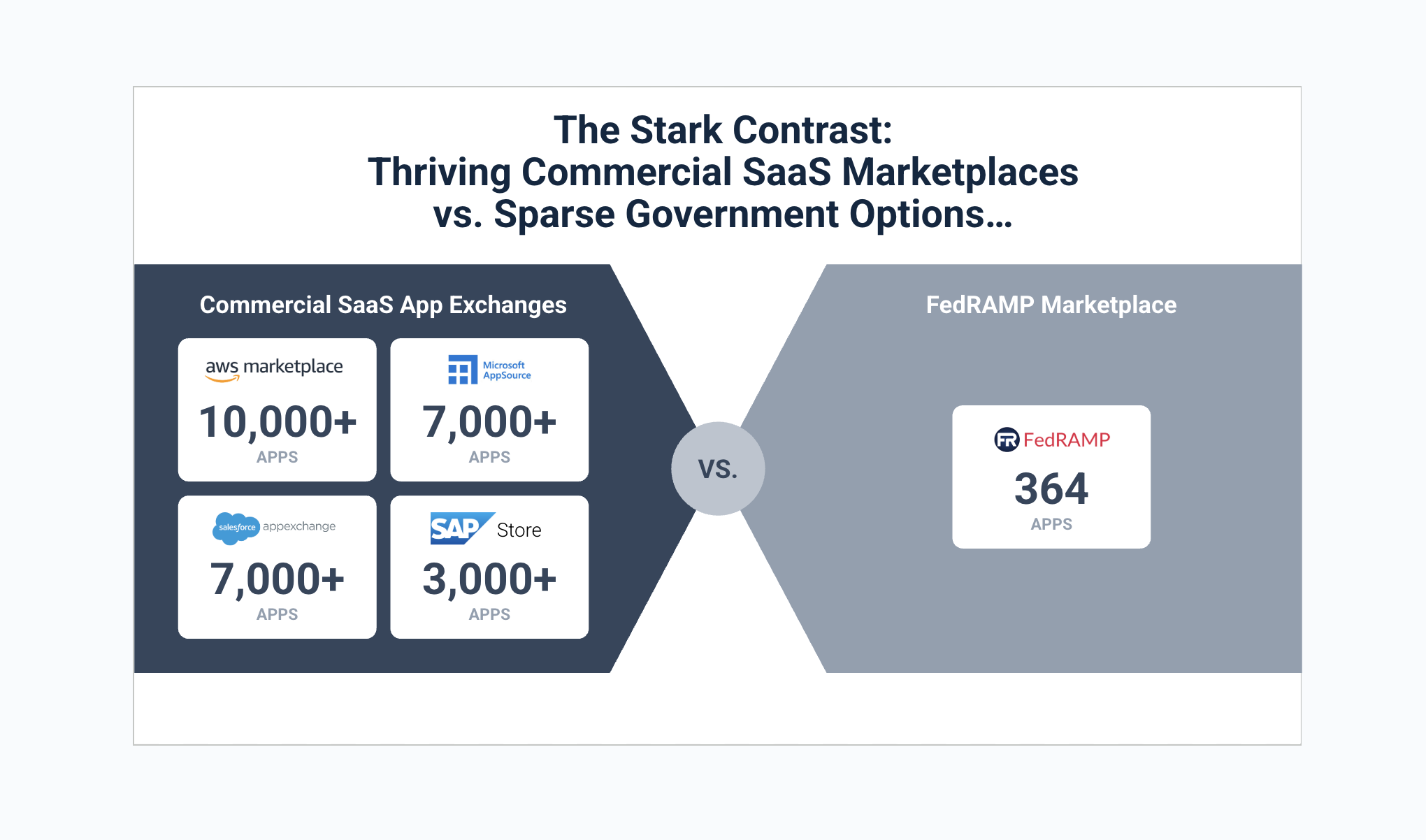
Introducing Knox Systems: Unlocking the Government SaaS Market with FedRAMP-as-a-Service
Introducing Knox Systems: Unlocking the Government SaaS Market with FedRAMP-as-a-Service
TL;DR
- FedRAMP 20x introduces a streamlined, developer-friendly approach to security compliance for cloud service providers (CSPs).
- It uses code-based JSON reporting to replace traditional manual documentation.
- Knox Systems’ CMX Platform adds the critical context and automation needed to make this approach work at scale.
What is FedRAMP 20x?
FedRAMP 20x is a transformative new government program announced on March 24, 2025, designed to modernize how cloud service providers (CSPs) demonstrate compliance with FedRAMP security standards.
Instead of relying on manual documents and static reports, FedRAMP 20x introduces a code-driven model for security validation. CSPs can use JSON objects with boolean expressions to represent their system’s current security state—for example: "encryption": true.
This approach aims to make FedRAMP compliance simpler, faster, and more transparent for both providers and agencies.
Why FedRAMP 20x Matters for Cloud Security
The traditional FedRAMP authorization process is known for being complex, outdated, and time-consuming. FedRAMP 20x changes that by:
- Reducing complexity in cloud security compliance
- Providing a clear, machine-readable security reporting model
- Helping agencies and auditors instantly assess security posture
But there's one big challenge: context.
Simplicity Needs Context
Even with automation, a simple flag like "encryption": true doesn’t tell the full story. CSPs still need to prove:
- Where encryption is applied (e.g., at rest, in transit, internal traffic)
- How it’s implemented (e.g., key management, algorithms, scope)
- Whether it complies with NIST 800-53, ZTA, and other frameworks
That’s where most compliance tools fall short.
How Knox Systems’ CMX Platform Complements FedRAMP 20x
The Knox CMX Platform fills the context gap by acting as a security automation platform that links together:
- GRC tools (Governance, Risk & Compliance)
- CNAPPs (Cloud-Native Application Protection Platforms)
- GitOps and Infrastructure-as-Code pipelines
- Hyperscale cloud providers like AWS, Azure, and GCP
With Knox, CSPs can:
- Generate continuous, real-time assessments
- Track and remediate POA&Ms (Plans of Action & Milestones)
- Maintain audit-ready compliance documentation
- Get prescriptive guidance for meeting security standards
The result? Simplified, continuous, and contextual compliance—all integrated into your DevSecOps workflows.
Why This Is a Big Deal for the Industry
FedRAMP 20x is more than a policy change. It marks a paradigm shift in how public-sector cloud security is defined, measured, and verified.
Security teams and CSPs that embrace this model early—especially those using tools like Knox Systems’ CMX Platform—will have a competitive edge in the government cloud marketplace.
Final Takeaway
March 24, 2025, marks the start of a new era in cloud compliance. FedRAMP 20x will reshape how we:
- Build secure systems
- Prove compliance
- And respond to emerging threats
With the Knox CMX Platform, your team is equipped to automate security context, deliver faster FedRAMP readiness, and stay ahead of evolving compliance frameworks.
Frequently Asked Questions
1. What is FedRAMP 20x and how does it change cloud compliance?
FedRAMP 20x is a new government initiative that modernizes compliance by using code-based JSON reporting instead of manual documentation, making cloud security verification faster and more transparent.
2. How does JSON-based reporting simplify the FedRAMP process?
JSON reporting lets CSPs represent their security posture in real time using machine-readable data, reducing manual paperwork and enabling agencies to instantly validate compliance.
3. Why does automation alone fall short in FedRAMP 20x compliance?
Automation without context cannot explain how or where controls like encryption are applied, which standards they meet, or how they align with frameworks such as NIST 800-53 or Zero Trust Architecture.
4. How does Knox Systems’ CMX Platform enhance FedRAMP 20x?
Knox CMX connects GRC systems, CNAPPs, GitOps, and major cloud providers to provide real-time context, automated remediation, and continuous compliance validation for FedRAMP 20x environments.
5. Why is FedRAMP 20x a major shift for government cloud providers?
It transforms compliance from static reporting to continuous validation, giving early adopters using AI-driven platforms like Knox CMX a significant advantage in speed, accuracy, and trust.
FedRAMP 20x: The Future of Simplified Cloud Security Compliance
FedRAMP 20x: The Future of Simplified Cloud Security Compliance
Knox has the most ATOs, the most flexible architecture, and the cheapest and fastest time-to-FedRAMP.
How does Knox Compare to the competition?
- Fastest and Cheapest Time-to-ATO
- Knox can secure an ATO in as fast as 90 days. How? Knox has invested in creating the largest boundary in the market across all AWS, Azure, GCP, and all major LLMS, allowing us to quickly map your architecture to our existing cloud.
- Most ATOs
- Knox has 13 ATOs, far surpassing competitors.
- With 9 years of FedRAMP approvals, Knox has more experience than competitors, ensuring a smoother, proven process.
- Most Flexible Architecture
- Infrastructure Agnostic Deploy: Deploy apps using Containerized, Microservice, Serverless or any other architecture. Knox does not require containerization.
In short, Knox offers the most ATOs, the fastest process, and the best cost-to-value ratio, making it the strongest choice in the market.
.jpeg)
The Knox Approach
The Knox Approach